
Runtime governance for AI agents applies policy to each prompt, response, tool call and agent-to-agent call at the moment an agent makes it, before the call executes, and writes a record that ties the action to the person whose authority the agent used. For a security leader at a regulated firm, it answers the questions that follow any agent incident: what the agent sent, on whose authority, under which policy, and who decided.
Agents already act inside regulated enterprises. Developers run coding agents with shell access. Business units connect assistants to customer records.
Updated November 19, 2026.
Regulatory references verified as of November 19, 2026.
Where AI agents already act
An agent reaches the enterprise along three paths:
- Model calls. Prompts and responses to frontier models in a provider's cloud and to models the enterprise runs itself.
- Tool calls. Database queries, API calls, file operations and messages, often over the Model Context Protocol (MCP).
- Agent-to-agent calls. Tasks handed from one agent to another, each with its own tools and its own log.
The MCP security guide covers the tool path.
An agent that can read email, query a CRM, run database queries and send messages has the access footprint of a privileged employee, and it chooses its own next step.
A public case shows what that means. In July 2025, Fortune reported that a Replit AI coding agent had deleted a live company database "during an active code freeze," wiping data for more than 1,200 executives, after, by the agent's own admission, violating explicit instructions not to proceed without human approval. Replit's chief executive, Amjad Masad, called it "Unacceptable and should never be possible." The instruction sat in the agent's input. A control outside the model applies the same rule whatever the model concludes. The AI agent governance guide covers the three paths in depth.
What runtime governance means
Runtime governance is policy applied at the point where an agent acts. Policy is decided before the call executes, written once and applied to every prompt, response and tool call, whether the model is rented or owned. Agent-to-agent calls go through the same policy.
The word that matters is "before." A log written after customer data reached a public model records a leak that has already happened. A runtime control applies the firm's policy while the call is in flight. Depending on that policy, the call proceeds, proceeds with sensitive fields redacted, goes to a model approved for that data class, or pauses for a person with approval rights.
The pause matters most in a regulated firm. A payment, a change to a customer record or a message sent in the firm's name pauses until a person with approval rights decides, and the decision joins the record.
Why identity, agent platforms and DLP leave a gap
Security teams often say they already have this covered, and point to three controls: identity and access governance, an agent or workflow platform with controls of its own, and data loss prevention.
| Control | The question it answers | What it sees | What it leaves to runtime |
|---|---|---|---|
| Identity and access governance | Who is this agent, and what may it access? | The identity, the entitlements, the token | The content of each call the correctly identified agent makes |
| Agent and workflow platforms | Which agent runs, for which task, on whose behalf? | Agents launched and tasks assigned inside that platform | Calls to models, tools and agents outside the platform, and the payload of each call |
| Data loss prevention | Is sensitive data leaving through a known channel? | Email, file transfer, web uploads | Long prompts, streamed responses, tool arguments and model-specific API calls |
| Runtime governance | Is this call, with these arguments, inside policy and the authority a person delegated? | Every prompt, response, tool call and agent-to-agent call on the path | It reads identity, entitlements and data classes from the other three |
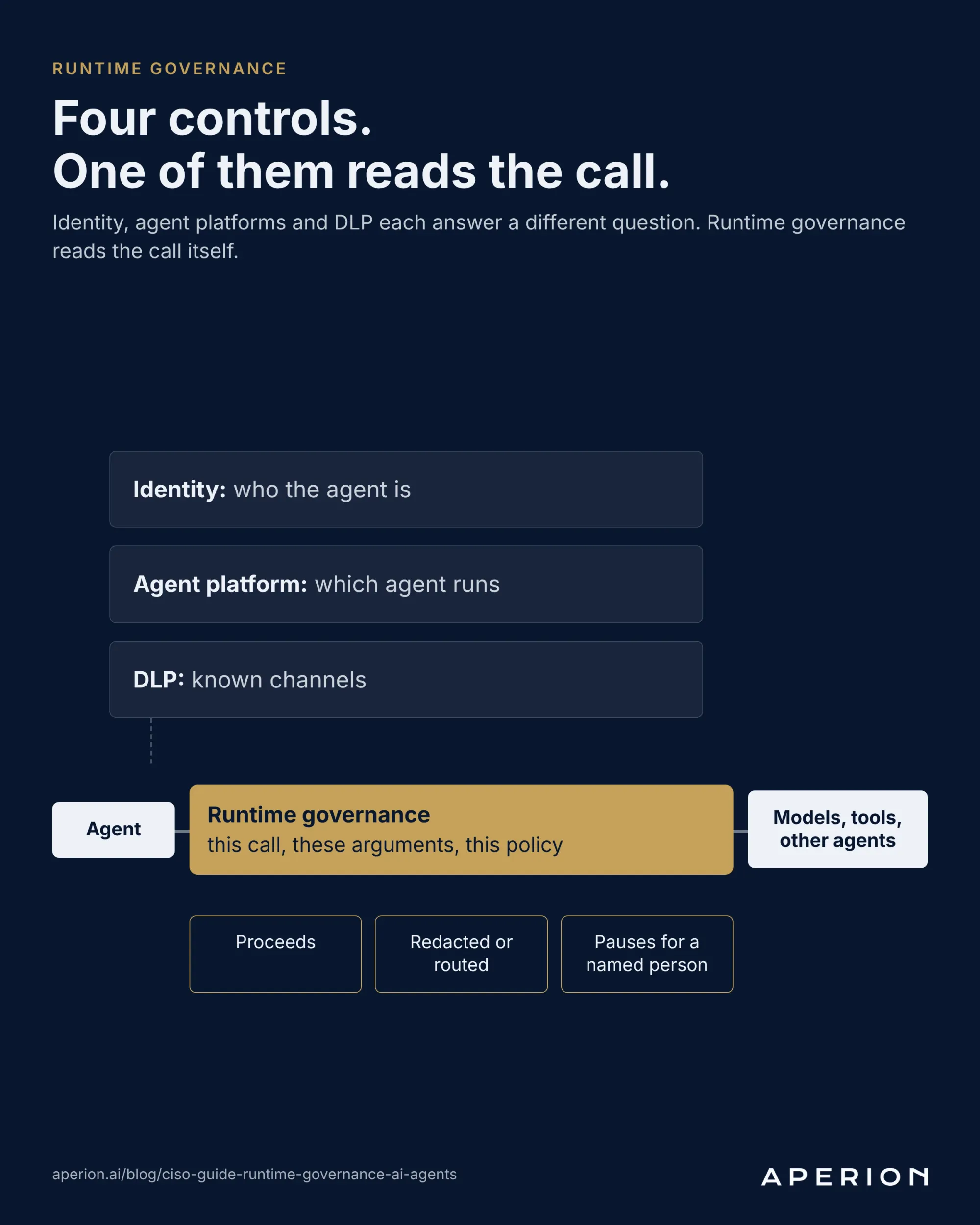
Identity stays upstream. An agent can be correctly authenticated and still send a customer's account number to a model the firm has not approved for that data. Identity approved the agent. It never read the payload.
Agent and workflow platforms see the agents they launch. A firm with three platforms, coding agents on developer laptops and models called directly from applications has agents that no single platform sees. Data loss prevention was built for channels with known shapes, and AI traffic arrives as long prompts, streamed responses and tool arguments.
Runtime governance composes with all three and reads from them: the person's current entitlements, the scope delegated, the data classification. Its job is the call itself.
The four questions a runtime layer has to answer
1. What did the agent send? The content: the prompt, the context retrieved, the tool arguments and the files attached.
2. What happens before it leaves? Policy has to act while the call is in flight: redact, route to a model approved for that data class, or pause for a named person. A control that writes an alert after the call reports the outcome.
3. Does it trace to a verified person? Every agent action should trace to the person whose authority it used. When one agent hands work to another, authority narrows down the chain and never widens. The AI agent authorization guide covers how authority is checked on each request.
4. Can you prove it to an examiner? Each record names the person, the agent, the model and its version, the provider, the policy that applied and who approved any exception. It reads the same whichever model did the work, and it sits with the enterprise's other regulated records. A record rebuilt from scattered logs after an exam notice arrives is an estimate. The tamper-evident audit log entry covers what makes a record evidence.
Prompt injection and the authority an agent carries
Attacks ride the agent's authority. The OWASP Top 10 for LLM Applications lists prompt injection first, as LLM01:2025: "A Prompt Injection Vulnerability occurs when user prompts alter the LLM's behavior or output in unintended ways." It adds: "Indirect prompt injections occur when an LLM accepts input from external sources, such as websites or files."
A support ticket, a web page or a tool's output can carry instructions written for the model. The agent has live credentials, so an injected instruction runs with whatever access the agent has. Identity sees a correctly identified agent, and the platform sees a task running as designed. The injected instruction becomes visible in the call itself, so the control has to read the call's content. The glossary covers prompt injection.
The joint guidance from six national cyber agencies, Careful Adoption of Agentic AI Services, released April 30, 2026, tells developers to construct each agent "as a distinct principal," with keys or certificates of its own. It tells operators to "Prevent agents from autonomously executing high impact actions or outputs without prior human approval." It tells developers and vendors to "Integrate unified audit logs for all inter-agent interactions to maintain observability of all agent exchanges."
An agent that borrows a person's key cannot be revoked without disabling the person, and its actions cannot be told apart from theirs. The step-up approval guide covers which actions should pause for a person and how.
Where the runtime layer should run
The runtime layer reads every prompt and response, so wherever it runs, the firm's most sensitive traffic runs too.
When the control point runs on infrastructure the enterprise controls, the policy, the evidence and the choice of model stay with the enterprise, whichever provider does the work. Prompts sent to a rented model still go to that provider's cloud, under the policy that allowed them.
A runtime layer hosted by a third party processes the firm's prompts and responses on that party's infrastructure, and its logs often stay there too. The firm then has to evidence a control it does not operate.
Three deployment options belong on the evaluation sheet: on-premises, in the firm's own cloud account, and air-gapped. The AI control plane guide covers where that enforcement point sits.
Mapping runtime evidence to the exam
SR 26-2 and model risk. The Federal Reserve, the OCC and the FDIC issued SR 26-2, Revised Guidance on Model Risk Management, on April 17, 2026. It supersedes SR 11-7 and SR 21-8. It states that it does not set forth enforceable standards, and it places generative and agentic AI outside its scope, leaving those systems to the institution's own risk management. Supervisory action can still follow unsafe or unsound practices, so examiners can raise findings about how a bank governs AI the guidance does not cover. A record of which model and version answered each request, under which policy, gives the bank its own monitoring evidence. The SR 26-2 guide maps each practice to LLMs and agents.
FINRA Rule 3110 and supervision. Rule 3110 requires each member to "establish and maintain a system to supervise the activities of each associated person" that is reasonably designed to achieve compliance with the securities laws and FINRA rules. Regulatory Notice 24-09, June 27, 2024, says FINRA's rules are "intended to be technology neutral" and continue to apply when firms use generative AI. An agent acting for a registered representative falls inside that supervisory system, and supervisors need a record of each action to review. Information barriers rest on a separate obligation: Section 15(g) of the Securities Exchange Act requires broker-dealers to establish, maintain and enforce written policies and procedures reasonably designed to prevent the misuse of material nonpublic information. An agent that reads across groups needs a policy that knows which side of the barrier its user sits on. The FINRA Rule 3110 guide goes further.
EU AI Act, Article 26. Deployers of high-risk AI systems "shall assign human oversight to natural persons who have the necessary competence, training and authority, as well as the necessary support" (Article 26(2)), monitor the system's operation (Article 26(5)), and keep the logs it generates, to the extent they are under their control, for at least six months (Article 26(6)). For financial institutions, the monitoring duty is met through the internal governance rules of EU financial services law, and the logs are kept with the documentation that law already requires. Regulation (EU) 2026/1744, in force since July 27, 2026, set the dates: Annex III high-risk systems from December 2, 2027, and high-risk systems embedded in products under Annex I from August 2, 2028. An agent falls under these duties when its use falls in a high-risk category.
What to do now
See it. Inventory the AI traffic: which agents call which models and tools, what data moves, where it goes and who owns each agent. The runtime layer produces that view because it sits where the traffic flows. The AI inventory guide and the shadow AI guide cover finding what the inventory misses.
Enforce at the highest-risk boundary first. Start where a failure costs most: agents that touch customer data, coding agents with shell access, model calls that leave the firm's network, and actions that move money or change records. Name the approvers, then widen as the records show what normal traffic looks like.
Make the evidence automatic. The record should be a byproduct of enforcement. If producing exam evidence is a project, the control sits in the wrong place.
How APERION approaches runtime governance
Owned intelligence, governed from the first call. Enterprises will rent some intelligence and own more of it.
The control point sits in the path between agents and every model and tool they call, rented or owned, and keeps each action inside the authority a person delegated. Global policy. Local enforcement. Portable evidence. APERION's Smartflow can serve as that runtime control point, with a record of every agent call bound to a named human principal.
The Trust Fabric sets out the four layers underneath: verified identity, access governance, runtime governance, and audit and evidence.
The proof is one call. An agent tried to wire $50,000 nobody approved. The amount exceeded the authority delegated to the agent. The action paused and went back to the person whose authority the agent was using, who decided with proof they were there. The accountable human decides, and the record shows who decided, when and under which policy.
A verified person, the authority that person delegated, the agent that used it, the policy that applied, the decision and the record of all of it. That chain is the product.
Frequently asked questions
What is runtime governance for AI agents?
Runtime governance applies policy to each prompt, response, tool call and agent-to-agent call at the moment an agent makes it, before the call executes. Depending on policy, the call proceeds, proceeds with fields redacted, goes to an approved model, or pauses for a person with approval rights. Each action is recorded with the person, the agent, the model, the policy and who decided.
How is runtime governance different from AI security monitoring?
Monitoring reads what happened and writes a log after the event, so a detected leak has still left the firm. Runtime governance acts while the call is in flight and writes the record as it acts. Firms need both: monitoring finds what policy missed, and runtime controls act before a model call or a high-risk action completes.
Does identity governance cover AI agents?
It covers who the agent is and what it may access, and runtime governance depends on it. Identity does not read what a correctly authenticated agent sends to a model or passes to a tool. An agent can be properly identified and still send a customer's account number to a model the firm has not approved for that data, so the call needs its own control.
Does SR 26-2 apply to generative AI and AI agents?
No. SR 26-2, issued April 17, 2026 by the Federal Reserve, the OCC and the FDIC, places generative and agentic AI outside its scope and leaves those systems to each institution's own risk management. Supervisory action can still follow unsafe or unsound practices, so examiners can raise findings about how a bank governs AI the guidance does not cover. Banks need their own controls and records.
What does FINRA Rule 3110 require when firms use AI agents?
Rule 3110 requires each member to maintain a supervisory system reasonably designed to achieve compliance with the securities laws and FINRA rules. FINRA's Regulatory Notice 24-09 says its rules are technology neutral and apply to generative AI. An agent acting for an associated person falls inside that system, so supervisors need a record of each agent action and who approved it.
Should a runtime governance layer run on-premises?
For a regulated firm, the option to run it on-premises, in the firm's own cloud account or air-gapped belongs on the evaluation sheet. The layer reads every prompt and response. When it runs on infrastructure the firm controls, the policy, the evidence and the choice of model stay with the firm. Prompts sent to a rented model still go to that provider's cloud, under the policy that allowed them.
Sources
- Fortune, An AI-powered coding tool wiped out a software company's database, then apologized for a 'catastrophic failure on my part', July 23, 2025. Opened November 5, 2026.
- OWASP GenAI Security Project, LLM01:2025 Prompt Injection. Opened November 19, 2026.
- ASD's ACSC, CISA, NSA, Canadian Centre for Cyber Security, NCSC-NZ and NCSC-UK, Careful Adoption of Agentic AI Services, released April 30, 2026, and the Canadian Centre for Cyber Security's announcement. Opened November 5, 2026.
- Board of Governors of the Federal Reserve System, SR 26-2, Revised Guidance on Model Risk Management, April 17, 2026. Opened November 19, 2026.
- FINRA, Rule 3110, Supervision. Opened November 19, 2026.
- FINRA, Regulatory Notice 24-09, June 27, 2024. Opened November 19, 2026.
- Securities Exchange Act of 1934, Section 15(g), 15 U.S.C. 78o(g). Opened November 19, 2026.
- EU Artificial Intelligence Act, Article 26, Obligations of deployers of high-risk AI systems. Opened November 19, 2026.
- Official Journal of the European Union, Regulation (EU) 2026/1744, July 8, 2026, and the European Commission, AI Omnibus enters into force, July 27, 2026. Opened November 19, 2026.
Related reading
- AI agent governance: a framework for MCP, A2A and the new attack surface
- AI agent authorization: why authority must be checked on every call
- Step-up approval for AI agents
- What is an enterprise AI firewall?
- What is a hybrid AI estate?
- The Trust Fabric
Related reading: Runtime security and runtime governance · The CISO's guide to AI security categories.

Put this in the path of your own agents.
Policy enforced inline between your agents and every model and tool they reach, with a record bound to the human who owns it.
Request a Demo Read the docs