
SR 26-2, the model risk guidance the Federal Reserve, the OCC and the FDIC issued on April 17, 2026, replaced SR 11-7 and placed generative and agentic AI models outside its scope in footnote 3. The same footnote tells each banking organization that its own risk management and governance practices should guide the controls for what the guidance leaves out. A bank governs its LLMs and agents by carrying the disciplines its model risk program already runs onto them, and by adding the controls agents need because they act.
Regulatory references verified as of November 4, 2026.
What SR 26-2 says about generative and agentic AI
SR 26-2, "Revised Guidance on Model Risk Management," is dated April 17, 2026. The attached supervisory guidance was issued jointly by the Board of Governors of the Federal Reserve System, the OCC and the FDIC. It supersedes and replaces SR 11-7, issued April 4, 2011, and SR 21-8, the 2021 interagency statement on model risk management for systems that support Bank Secrecy Act and anti-money laundering compliance.
Each agency issued its own release the same day. OCC Bulletin 2026-13 rescinds OCC Bulletin 2011-12, Bulletin 2021-19, Bulletin 1997-24 on credit scoring models, and the "Model Risk Management" booklet of the Comptroller's Handbook. The FDIC's FIL-15-2026 rescinds FIL-22-2017 and FIL-27-2021. All three point to the same guidance text.
Section II, Purpose and Scope, defines a model as "a complex quantitative method, system, or approach that applies statistical, economic, or financial theories to process input data into quantitative estimates." The next sentence excludes simple arithmetic calculations and deterministic rule-based processes and software. Footnote 3 attaches to that sentence and reads in full:
"Generative AI and agentic AI models are novel and rapidly evolving. As such, they are not within the scope of this guidance. Nonetheless, a banking organization's risk management and governance practices should guide the determination of appropriate governance and controls for any tools, processes, or systems not covered in this document. However, the principles described in this guidance apply to traditional statistical and quantitative models and non-generative, non-agentic AI models."
The letter is "expected to be most relevant to banking organizations with over $30 billion in total assets." The guidance states that it "does not set forth enforceable standards or prescriptive requirements," and that non-compliance with it "will not result in supervisory criticism." Footnote 1 of the attachment adds that violations of law and unsafe or unsound practices stemming from insufficient management of model risk remain within supervisory reach.
A machine learning credit score or a fraud classifier sits inside the guidance. A large language model that drafts customer letters, and an agent that files a dispute or moves money, sit outside it. The SR 11-7 and SR 26-2 glossary entry covers what carried forward from 2011.
What still reaches a bank's LLMs and agents
Footnote 3 removes generative and agentic AI from one guidance document. Four sources of expectation still apply.
The bank's own governance. The footnote's second half points back to the bank: its risk management and governance practices should guide the determination of the controls. An examiner who asks how the bank governs its language models expects a documented answer.
Third-party risk management. A model a bank rents from a provider is a third-party relationship, and so is an AI feature inside a SaaS tool it licenses. The third-party risk guide for AI model providers covers the interagency guidance, the September 2026 proposal to replace it, and what to ask each provider.
Supervisory questions. On October 13, 2026, Reuters reported that the OCC, the FDIC and the Federal Reserve were sending "written and verbal inquiries to large, mid-size and smaller banks" about AI. The questions it described include "whether banks can clearly track and audit AI agent decisions," "what safeguards exist to prevent agents from exceeding their authority," "whether humans remain involved in key decisions" and "how banks can shut down autonomous systems."
FINRA, for broker-dealers. FINRA's Regulatory Notice 24-09, issued June 27, 2024, says its rules are "intended to be technology neutral." It adds that a firm using Gen AI tools as part of its supervisory system should have policies and procedures that "address technology governance, including model risk management." The FINRA Rule 3110 guide covers the enforceable supervision rule.
NIST's Generative AI Profile, NIST AI 600-1 from July 2024, opens its inventory action GV-1.6-001 with "Enumerate organizational GAI systems for incorporation into AI system inventory."
Model risk practice, mapped to LLMs and agents
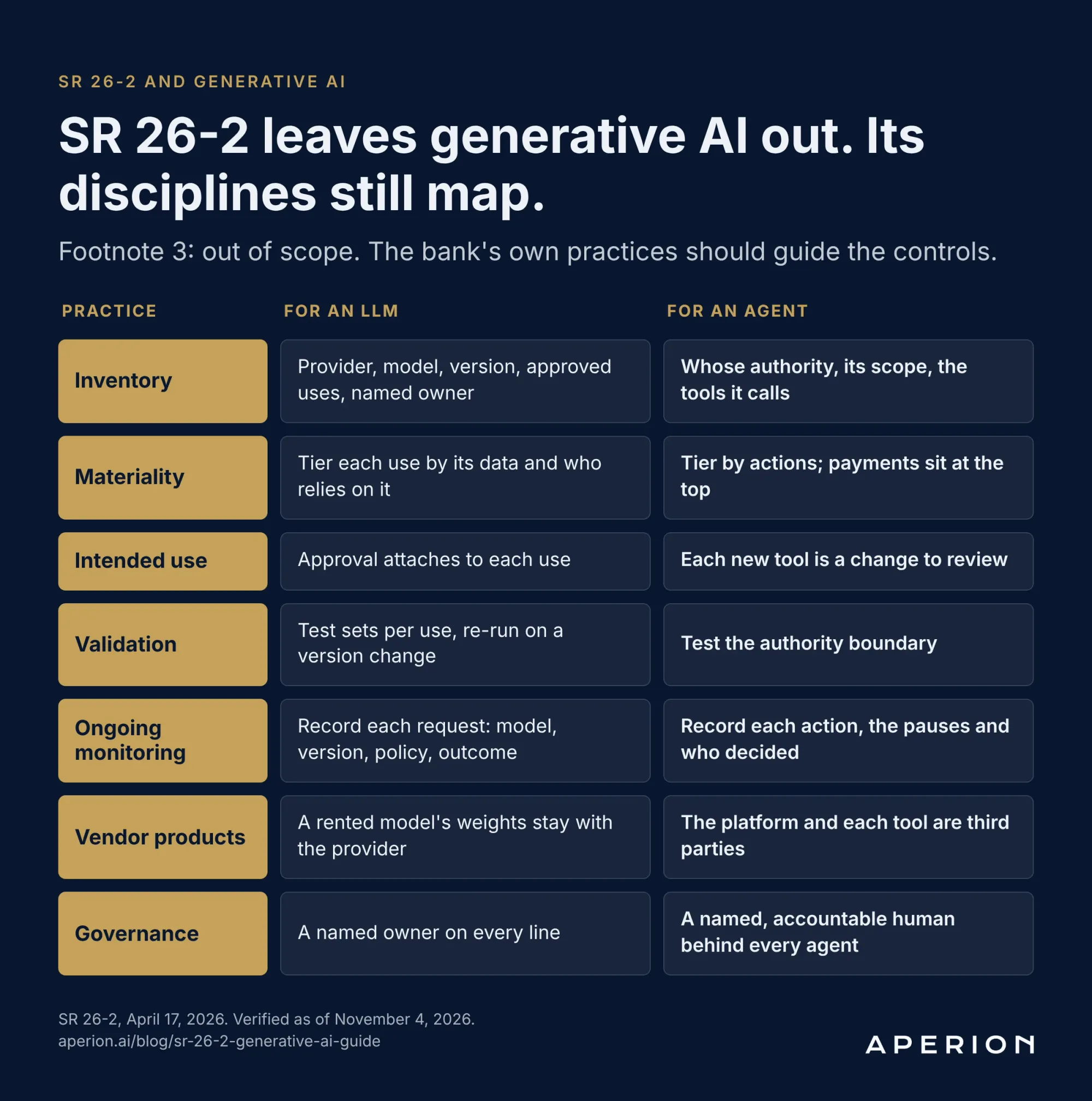
SR 26-2 does not require its disciplines for generative AI. A bank that already runs them for its credit and fraud models has the people, the committees and the vocabulary to extend them, and footnote 3 asks it to decide how.
| Practice in SR 26-2 | What the guidance says | Applied to an LLM | Applied to an agent |
|---|---|---|---|
| Inventory (Section VI) | An effective inventory "includes sufficient information to understand model risks" at the individual and aggregate levels | Provider, model and version, where it runs, each approved use, the data classes it may receive, a named owner | The person whose authority it uses, the scope of that authority, the models and tools it calls, the actions that need approval |
| Materiality (Section III) | "Model purpose, together with model exposure, determines model materiality." | Tier each use by the data it touches and who relies on the output | Tier by the actions it can take; a payment or a change to a customer record sits at the top |
| Intended use (Section IV) | "Using a model beyond its intended purpose introduces additional uncertainty and risk." | One model serves many prompts, so approval attaches to each use | Each new tool extends what the agent can do and is a change to review |
| Validation and effective challenge (Sections III and V) | Conceptual soundness and outcomes analysis, with critical analysis by objective experts | Test sets drawn from the approved uses, re-run when the provider changes the version | Tests of the authority boundary: what the agent may do on its own and what pauses for a person |
| Ongoing monitoring (Section V) | An evaluation of "the extent to which a model is performing as expected" | A record of each request: model, version, policy applied, outcome | A record of each action, including the actions that paused and who decided |
| Vendor and third-party products (Section VII) | Banks "may not receive from the vendor the underlying code, data, or methodology" | Weights and training data of a rented frontier model stay with the provider; the third-party program covers the provider | The agent platform and each external tool are third parties in their own right |
| Governance and controls (Section VI) | Clear policies and effective controls, with practices "commensurate with that risk" | A named owner on every line of the inventory | A named, accountable human behind every agent |
Where an LLM strains the model risk toolkit
The practices carry over. Four assumptions behind them do not.
The output is text. SR 26-2 describes outcomes analysis as comparing "model outputs to corresponding real-world outcomes." A drafted complaint response has no single outcome to compare against. Evaluation moves to defined test sets for each approved use, sampled review of production output, and records of what the model was asked and what it returned.
The version changes on someone else's schedule. A validation describes a version. A rented model's provider updates and retires versions on its own timeline, which the model drift entry covers. Ongoing monitoring has to record which version answered each request, so a change shows up in the bank's own records.
One model serves many purposes. A language model behind an internal assistant answers policy questions, summarizes call notes and drafts emails in the same afternoon. Intended-use discipline moves from the model to the use: the bank approves uses and data classes, and each new use goes through review.
Agents act. A credit model produces an estimate, and the bank's process decides what to do with it. An agent calls tools and takes actions on a person's delegated authority, and the action can complete before anyone reviews it. Control has to sit before the action: a defined agent authority scope, a policy applied at runtime, and a named human on high-risk actions.
Building the framework footnote 3 asks for
Six elements make the determination footnote 3 asks for documentable.
1. A recorded scope decision
For each AI system, record whether it sits in the model risk program or under the bank's generative AI governance, who decided and on what date.
2. One inventory for both
Language models and agents go on the same inventory as the credit and fraud models, with fields for each kind of entry. The AI inventory guide lists the fields, and NIST AI 600-1 GV-1.6-001 calls for enumerating generative AI systems into the AI system inventory.
3. Tiers by use and by action
Materiality for a language model follows the data each use touches and who relies on the output. Materiality for an agent follows the actions it can take.
4. Approved uses and limits set before the call
The bank names which models each team may use, for which uses and with which data classes, and applies that policy to every prompt, response and tool call before it executes. A model allowlist is where the permitted models are named.
5. A named human on high-risk actions
A payment, a change to a customer record or a message sent in the bank's name pauses until a person with approval rights decides, and the decision joins the record. This answers two of the questions Reuters reported: what stops an agent exceeding its authority, and whether humans remain involved in key decisions.
6. Evidence in the bank's own records
Each record names the person, the agent, the model and its version, the provider, the policy that applied and who approved any exception. It sits with the bank's other regulated records, under its own retention rules. The tamper-evident audit log entry covers what makes a record evidence, and the examination readiness page maps records to what examiners request.
Four questions to answer before an examiner asks
- Which of our AI systems sit outside SR 26-2, who decided, and where is that recorded?
- For each language model and agent, who owns it, which version answered last week, and which uses are approved?
- What stops an agent from acting beyond the authority a person delegated to it, and who decides when it tries?
- How would we shut down an agent today, and how long would it take?
How APERION governs the hybrid AI estate
Owned intelligence, governed from the first call. APERION future-proofs the hybrid AI estate: every agent and every model an enterprise rents or owns, governed from one control point inside its own walls. Enterprises will rent some intelligence and own more of it. Do not let the model provider become the architecture. The thesis is set out in full on AI governance and why APERION.
The control point sits in the path between agents and every model and tool they call, rented or owned, and keeps each action inside the authority a person delegated. Global policy. Local enforcement. Portable evidence. The policy is written once for the whole estate, it is enforced at the control point inside the enterprise's walls, and the evidence stays with the enterprise.
The Trust Fabric sets out the four layers underneath: verified identity, access governance, runtime governance, and audit and evidence.
The proof is one call. An agent tried to wire $50,000 nobody approved. The amount exceeded the authority delegated to the agent. The action paused and went back to the person whose authority the agent was using, who decided with proof they were there. The accountable human decides, and the record shows who decided, when and under which policy.
A verified person, the authority that person delegated, the agent that used it, the policy that applied, the decision and the record of all of it. That chain is the product.
Frequently asked questions
What is SR 26-2?
SR 26-2 is the Federal Reserve's letter "Revised Guidance on Model Risk Management," dated April 17, 2026. Its attached guidance was issued jointly by the Federal Reserve, the OCC and the FDIC. It supersedes SR 11-7 and SR 21-8 and covers model development, use, validation, monitoring, governance and vendor products. The letter says it is expected to be most relevant to banking organizations with over $30 billion in total assets.
Does SR 26-2 apply to generative AI and large language models?
No. Footnote 3 states that generative AI and agentic AI models "are novel and rapidly evolving" and "are not within the scope of this guidance." It points each banking organization to its own risk management and governance practices to guide the controls for systems the guidance does not cover. The principles still apply to traditional statistical and quantitative models and to non-generative, non-agentic AI models.
Did SR 26-2 replace SR 11-7?
Yes. SR 26-2 supersedes and replaces SR 11-7, issued April 4, 2011, and SR 21-8, issued April 9, 2021. The OCC rescinded its parallel Bulletin 2011-12 in Bulletin 2026-13, and the FDIC rescinded FIL-22-2017 in FIL-15-2026, both on April 17, 2026. Inventory, validation, ongoing monitoring and governance carried forward, applied with rigor commensurate with each model's risk.
If generative AI is out of scope, what governs a bank's LLMs and agents?
The bank's own risk management and governance practices, as footnote 3 says. A rented model also goes through the third-party risk program, broker-dealers remain subject to FINRA Rule 3110, and Reuters reported in October 2026 that the OCC, the FDIC and the Federal Reserve are asking banks how they track agent decisions, limit agent authority, keep humans in key decisions and shut agents down.
Is SR 26-2 enforceable?
The guidance states that it "does not set forth enforceable standards or prescriptive requirements" and that non-compliance with it "will not result in supervisory criticism." Its first footnote keeps violations of law and unsafe or unsound practices stemming from insufficient management of model risk within supervisory reach. Examiners can still raise findings about how a bank governs AI the guidance does not cover.
Should a bank keep its LLMs and agents in the model inventory?
A bank needs one record of every AI system it uses, whether or not SR 26-2 covers it: an owner, approved uses, data classes and, for agents, the authority each one carries. Keeping language models and agents on the same inventory as traditional models lets the bank answer for its whole estate from one record. NIST AI 600-1 GV-1.6-001 calls for adding generative AI systems to the AI system inventory.
Sources
- Federal Reserve, SR 26-2: Revised Guidance on Model Risk Management, letter page, April 17, 2026. Opened November 4, 2026.
- Federal Reserve, OCC and FDIC, SR 26-2 with attached Supervisory Guidance on Model Risk Management, PDF, April 17, 2026; Section II and footnotes 1 and 3. Opened November 4, 2026.
- Federal Reserve, OCC and FDIC, Supervisory Guidance on Model Risk Management, attachment to SR 26-2; Sections III to VII. Opened November 4, 2026.
- OCC, Bulletin 2026-13, Model Risk Management: Revised Guidance, April 17, 2026. Opened November 4, 2026.
- FDIC, FIL-15-2026, Agencies Revise the Interagency Model Risk Management Guidance, April 17, 2026. Opened November 4, 2026.
- Reuters, Banking watchdogs ramp up AI scrutiny as stability fears mount, sources say, October 13, 2026, as published by Khaleej Times. Opened November 4, 2026.
- FINRA, Regulatory Notice 24-09, June 27, 2024. Opened November 4, 2026.
- NIST, Artificial Intelligence Risk Management Framework: Generative Artificial Intelligence Profile, NIST AI 600-1, July 2024; GV-1.6-001. Opened November 4, 2026.
Related reading

Put this in the path of your own agents.
Policy enforced inline between your agents and every model and tool they reach, with a record bound to the human who owns it.
Request a Demo Read the docs