
MCP security is the practice of governing what AI agents can reach through the Model Context Protocol: which servers they may connect to, which tools on those servers they may call, whose credential each call carries, what comes back into the model's context, and what happens to a call that skips the governed path. The protocol defines how tools are described and invoked. Its specification leaves enforcement to whoever runs the agents.
Every major agent platform now speaks MCP, so the tool path is a place where a single set of rules can cover agents from every vendor. This guide is part of the series on the hybrid AI estate.
Specification and incident references verified as of October 28, 2026.
Why the tool path is the control point
The MCP specification defines tools as "Functions for the AI model to execute." Its security principles add that "Tools represent arbitrary code execution and must be treated with appropriate caution," and that hosts "must obtain explicit user consent before invoking any tool." The same section states the limit plainly: "MCP itself cannot enforce these security principles at the protocol level." The protocol carries the call, and the enterprise decides whether it should happen.
A tool call is two things at once, as the MCP glossary entry puts it: a data flow and a permission decision. The agent sends arguments out, and the tool's answer comes back into the model's context, where the model treats it as input to its next step.
The platforms converged on the same interface. Part 7 of our Agent Platforms series, on Google, ServiceNow, OpenAI, Anthropic and LangChain agents, found that all five support MCP, as do Microsoft, Salesforce, Amazon, Glean and CrewAI. Its fifth rule follows from that: put the tool path under one set of rules, so tool rules, approvals and the audit record are the same whichever vendor's agent made the call. Our guide to governing AI agents across platforms maps where each platform's own controls stop.
How MCP attacks work
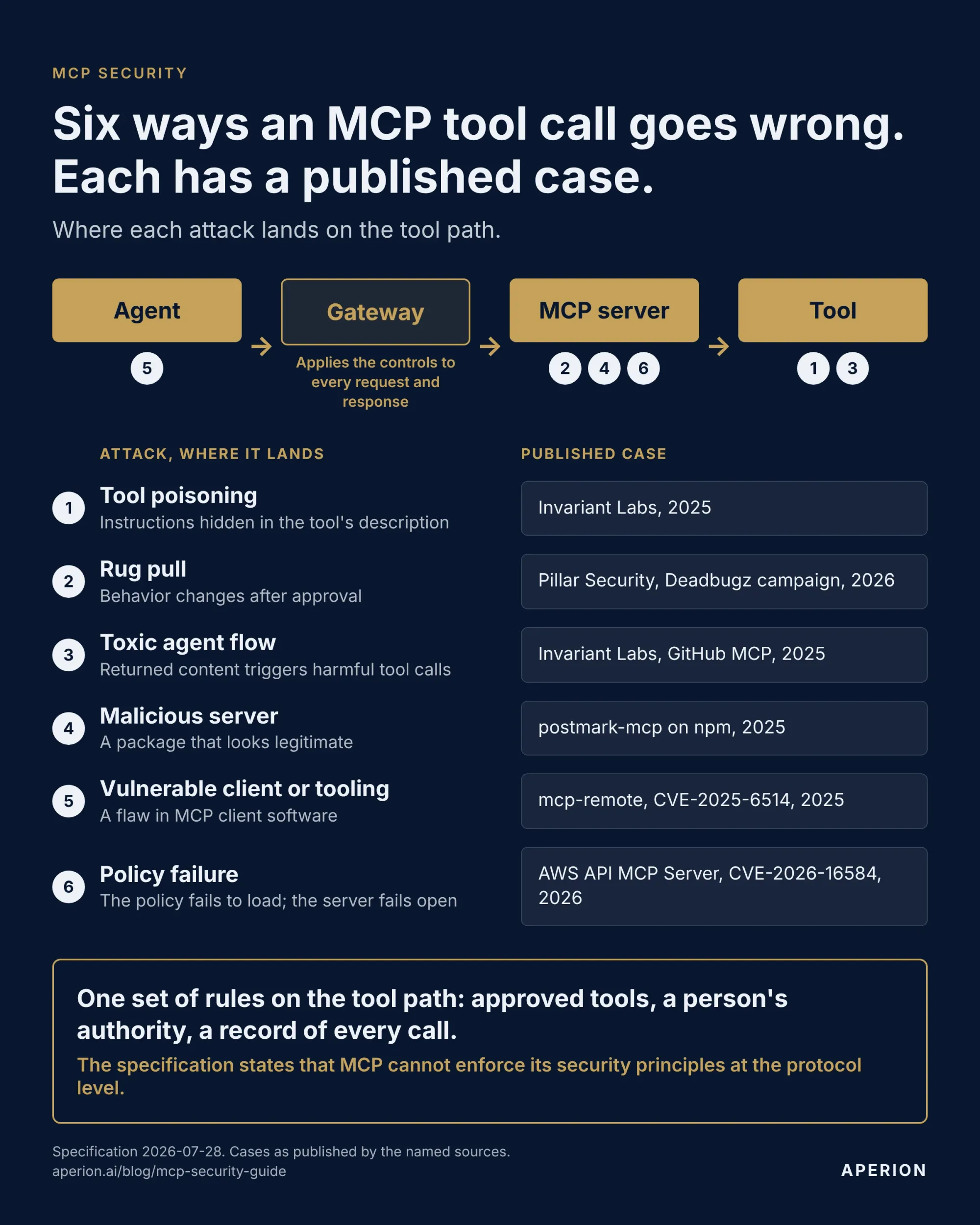
Published MCP attacks fall into six patterns, each with a dated case. OWASP's Top 10 for Agentic Applications, released in December 2025, lists tool misuse among the top risks for agents.
| Attack | What happens | Published case | Control that answers it |
|---|---|---|---|
| Tool poisoning | Instructions hidden in a tool's description steer the model | Invariant Labs, April 2025 | Review and pin tool descriptions |
| Rug pull | A server behaves during evaluation, then changes what it returns | Invariant Labs, April 2025; Pillar Security, Deadbugz campaign, August 2026 | Detect changes after approval |
| Toxic agent flow | Content an agent reads triggers a harmful sequence of tool calls | Invariant Labs, GitHub MCP, May 2025 | Inspect what comes back; limit what one session may combine |
| Malicious server | A package that looks legitimate exfiltrates data | postmark-mcp on npm, September 2025 | An inventory of approved servers with owners |
| Vulnerable client or tooling | A flaw in MCP software runs an attacker's code | mcp-remote, CVE-2025-6514; MCP Inspector, CVE-2025-49596 | Patch and version the MCP software in the inventory |
| Policy failure | A server fails open, or serves one tenant's data to another | AWS API MCP Server, CVE-2026-16584; Asana, June 2025 | Fail closed; test isolation |
Tool poisoning. Invariant Labs named the attack in April 2025: it "occurs when malicious instructions are embedded within MCP tool descriptions that are invisible to users but visible to AI models." The tool poisoning entry covers why a one-time review of a server does not settle it.
Rug pull. Invariant Labs described the rug pull in April 2025: "a malicious server can change the tool description after the client has already approved it." In August 2026 Pillar Security reported "an active campaign to distribute a malicious Model Context Protocol (MCP) server through public GitHub pull requests" that worked this way. The server offered text formatting and summarization. After three tool calls, it changed the instructions it returned and told the agent to look for SSH keys, cloud credentials and shell history.
Toxic agent flow. In May 2025 Invariant Labs showed that a malicious GitHub issue could hijack an agent connected to the GitHub MCP server and "coerce it into leaking data from private repositories." The researchers placed the problem at the agent system level, in how the agent combined tools. The indirect prompt injection entry covers the mechanism.
Malicious server. In September 2025 Koi Security found that version 1.0.16 of the postmark-mcp package on npm added a hidden BCC that copied every email the agent sent to an outside address. The Hacker News reported Koi calling it "the world's first sighting of a real-world malicious MCP server."
Vulnerable client or tooling. JFrog disclosed CVE-2025-6514 in mcp-remote in July 2025, rated CVSS 9.6, which allowed "arbitrary OS command execution on the machine running mcp-remote" when a client connected to an untrusted server. Oligo Security disclosed CVE-2025-49596 in Anthropic's MCP Inspector, rated 9.4, the month before.
Policy failure. AWS's bulletin for CVE-2026-16584 describes an MCP server that, when configured without its fail-closed modes and unable to load its security policy at startup, kept running "with the per-request policy check skipped" for the lifetime of the process. AWS fixed it in version 1.3.47. In June 2025 Asana took its MCP server offline after a logic flaw exposed some customers' data to other organizations; BleepingComputer reported roughly 1,000 customers affected.
The lethal trifecta
Simon Willison gave the risk a name in June 2025: the lethal trifecta of private data, untrusted content and external communication. An agent with all three can be tricked into reading private data and sending it to an attacker.
Adversa AI's AI Risk Quadrant for the second quarter of 2026 scored 100 agents and found its version of the trifecta, private data access, exposure to untrusted content and the ability to execute tools, in 98% of them. Of the 100, 11% were both capable and well-defended.
Decide which combinations a single session may hold, and treat any tool that returns outside content as a source of instructions until it is inspected.
What the specification requires, and what it leaves to you
The 2026-07-28 specification sets several hard rules for servers and clients, and leaves the rest as guidance.
- Authorization is optional. "Authorization is OPTIONAL for MCP implementations." Where it is used, authorization servers "MUST implement OAuth 2.1," and clients must name the target resource under RFC 8707.
- Tokens are bound to their audience. "MCP servers MUST NOT accept any tokens that were not explicitly issued for the MCP server." Token passthrough, where a server forwards a client's token to a downstream API, "is explicitly forbidden."
- Confused deputy. Proxy servers that sit in front of third-party APIs "MUST implement per-client consent and proper security controls."
- A state handle proves nothing. The protocol is now stateless, and servers "MUST NOT treat possession of a state handle as authentication."
- Annotations start untrusted. Clients "MUST consider tool annotations to be untrusted unless they come from trusted servers."
- A human can say no. "There SHOULD always be a human in the loop with the ability to deny tool invocations," and clients should "Log tool usage for audit purposes."
The MUST rules govern how each server and client behaves. Which servers an agent may reach, which tools it may call, under whose authority, and what the record shows are decisions the specification leaves to the enterprise.
Eight controls for the tool path
1. Inventory every MCP server, with an owner
List every server each agent can reach, local and remote, with its version, its owner and the data it touches. The official MCP Registry, launched in preview in September 2025, is "an open catalog and API for publicly available MCP servers." Maintainers publish self-reported information, and moderators can denylist entries after the fact. The AI bill of materials entry covers what to record.
2. Approve tools one at a time
A server that offers read and delete needs the two governed separately. Approve tools individually, and let a deny rule override an allow rule, so a permissive rule cannot defeat a restrictive one. The MCP security entry sets out the four questions a control has to answer: which servers, which tools, whose credential, and what happens off-path.
3. Pin descriptions and watch for change
Record each approved tool's name, description and parameters at approval. A change after approval sends the tool back for review before the next call. Pin prompts the same way. A rug pull shows up as a change against the record.
4. Bind every call to a person's authority
Every tool call carries the authority of a named person, through a token issued for that server and that purpose. The agent's scope stays inside that person's, as the agent authority scope entry and the AIDA guide explain. Shared service credentials and passed-through tokens break the chain.
5. Inspect what comes back
A tool's response enters the model's context and shapes its next action. Check responses for instructions, secrets and data the session is not allowed to hold, the same way requests are checked on the way out.
6. Pause high-risk actions for a named human
A payment, a deletion, a change to a customer record or a message sent in the firm's name waits until a person with approval rights decides. The human in the loop entry separates gating an action from monitoring it.
7. Close the bypass and fail closed
If an agent can reach a server directly and succeed, the governed path is optional. Route every remote server through one enforcement point, deny direct routes, and make a policy failure stop the call. The AWS bulletin above is the case for it.
8. Record every call
Each record names the person, the agent, the server, the tool, the arguments, the policy that applied and who approved any exception. The tamper-evident audit log entry covers what makes a record evidence.
Where an MCP gateway fits
An MCP gateway sits between agents and the remote servers they call and applies these controls to every request and response. It is how one policy covers agents from different vendors, and it is the enforcement point the enterprise AI gateway guide describes for model calls, applied to tools.
Local servers are a second front. Many developers run MCP servers on their own machines over standard input and output, out of reach of a network gateway. The specification's guidance for local servers is to "Execute MCP server commands in a sandboxed environment with minimal default privileges." A local guardrail on the developer's machine covers that case. For individual developers, APERION Shield is a free, local guardrail for MCP tool calls.
Questions to ask about your own tool path
- How many MCP servers can your agents reach today, and who owns each one?
- Which tools on those servers can delete, pay, send or change a record?
- When a tool's description changes, who finds out, and before which call?
- Whose credential does each call carry, and could a token issued for one server reach another?
- Can an agent reach any server directly, around the governed path?
- If an examiner asks which agent called which tool on whose authority last Tuesday, how many systems do you query?
How APERION governs the tool path
APERION is runtime governance for AI agents. It enforces policies and controls in real time across an enterprise's AI agents, maintains human accountability, and captures auditable evidence for every decision.
Owned intelligence, governed from the first call. APERION future-proofs the hybrid AI estate: every agent and every model an enterprise rents or owns, governed from one control point inside its own walls.
The control point sits in the path between agents and every model and tool they call, rented or owned, and keeps each action inside the authority a person delegated. APERION's Smartflow can front the MCP servers your agents call, so tool rules, approvals and the record are the same whichever vendor's agent made the call. Global policy. Local enforcement. Portable evidence.
The Trust Fabric sets out the four layers underneath: verified identity, access governance, runtime governance, and audit and evidence. The proof is one call. An agent tried to wire $50,000 nobody approved. The amount exceeded the authority delegated to the agent. The action paused and went back to the person whose authority the agent was using, who decided with proof they were there. The accountable human decides, and the record shows who decided, when and under which policy.
A verified person, the authority that person delegated, the agent that used it, the policy that applied, the decision and the record of all of it. That chain is the product.
Frequently asked questions
What is MCP security?
MCP security is the practice of governing what AI agents can reach through the Model Context Protocol: which servers they may connect to, which tools they may call, whose credential each call carries, what comes back into the model's context, and what happens to a call that skips the governed path. The MCP specification states that the protocol cannot enforce its own security principles, so enforcement falls to the enterprise.
What is MCP tool poisoning?
Tool poisoning hides instructions in a tool's description, name or parameter documentation. The model reads the description to decide how to use the tool and follows the hidden instructions; the user usually never sees them. Invariant Labs named the attack in April 2025. A related attack, the rug pull, changes a server's behavior after it has been reviewed, so descriptions need pinning and change detection.
What is an MCP gateway?
An MCP gateway sits between AI agents and the remote MCP servers they call. It applies one set of rules to every tool call: which servers and tools are approved, whose authority the call carries, which actions pause for a person, and what is recorded. Because every major agent platform supports MCP, a gateway lets one policy cover agents from different vendors.
Does the MCP specification include security controls?
It includes rules for servers that use authorization: OAuth 2.1, tokens issued for the specific server, no token passthrough and per-client consent for proxy servers. Authorization itself is optional. The specification says tool annotations are untrusted by default and that a human should be able to deny tool calls, and it states that MCP cannot enforce these principles at the protocol level.
What is the lethal trifecta for AI agents?
Simon Willison's term for an agent that combines access to private data, exposure to untrusted content and the ability to communicate externally. An attacker who controls the untrusted content can instruct the agent to send the private data out. MCP makes the combination easy because each capability is one more server. The defense is to limit which combinations one session may hold and to inspect tool responses.
Who is accountable when an AI agent calls a tool through MCP?
The person whose authority the agent was using. Each call should carry that person's delegated authority, stay inside its scope, and be recorded with the agent, the server, the tool, the policy that applied and who approved any exception. High-risk actions, such as a payment or a deletion, should pause until a person with approval rights decides.
Sources
- Model Context Protocol, Specification, version 2026-07-28. Opened October 28, 2026.
- Model Context Protocol, Tools, specification 2026-07-28. Opened October 28, 2026.
- Model Context Protocol, Security Best Practices, specification 2026-07-28. Opened October 28, 2026.
- Model Context Protocol, Authorization, specification 2026-07-28. Opened October 28, 2026.
- Model Context Protocol, Introducing the MCP Registry, September 8, 2025. Opened October 28, 2026.
- Invariant Labs, MCP Security Notification: Tool Poisoning Attacks, April 1, 2025. Opened October 28, 2026.
- Invariant Labs, GitHub MCP Exploited: Accessing private repositories via MCP, May 26, 2025. Opened October 28, 2026.
- Pillar Security, Deadbugz: Currently Active MCP Supply-Chain Campaign, August 12, 2026. Opened October 28, 2026.
- The Hacker News, First Malicious MCP Server Found Stealing Emails in Rogue Postmark-MCP Package, September 29, 2025. Opened October 28, 2026.
- JFrog, Critical RCE Vulnerability in mcp-remote: CVE-2025-6514 Threatens LLM Clients, July 9, 2025. Opened October 28, 2026.
- Oligo Security, Critical RCE Vulnerability in Anthropic MCP Inspector, CVE-2025-49596, June 27, 2025. Opened October 28, 2026.
- AWS, Security Bulletin 2026-063-AWS: AWS API MCP Server Security Policy Bypass via Startup Failure, July 23, 2026. Opened October 28, 2026.
- BleepingComputer, Asana warns MCP AI feature exposed customer data to other orgs, June 18, 2025. Opened October 28, 2026.
- Simon Willison, The lethal trifecta for AI agents: private data, untrusted content, and external communication, June 16, 2025. Opened October 28, 2026.
- Adversa AI, AI Risk Quadrant for Agent Security, Q2 2026, June 3, 2026. Opened October 28, 2026.
- OWASP GenAI Security Project, OWASP Top 10 for Agentic Applications, December 9, 2025. Opened October 28, 2026.
Related reading

Put this in the path of your own agents.
Policy enforced inline between your agents and every model and tool they reach, with a record bound to the human who owns it.
Request a Demo Read the docs