
Permits, utility power and GPUs arrive on their own schedule. Demand does not wait for them. APERION Smartflow runs inside the facility, in the path of every AI call, so tenants ramp on what is energized today and scale as the rest comes online, metered and governed per tenant.
Three schedules the developer does not set
- Permits. Siting, zoning and environmental approvals decide when a site can start, and when it can expand.
- Utilities. Power is delivered in phases, on the utility's schedule. A facility runs for a long time on part of its planned load.
- GPUs. Accelerators arrive on allocation, in tranches. The hall is ready before the hardware that fills it.
The developer cannot speed up any of the three. It can decide how much tenant work the live capacity carries.
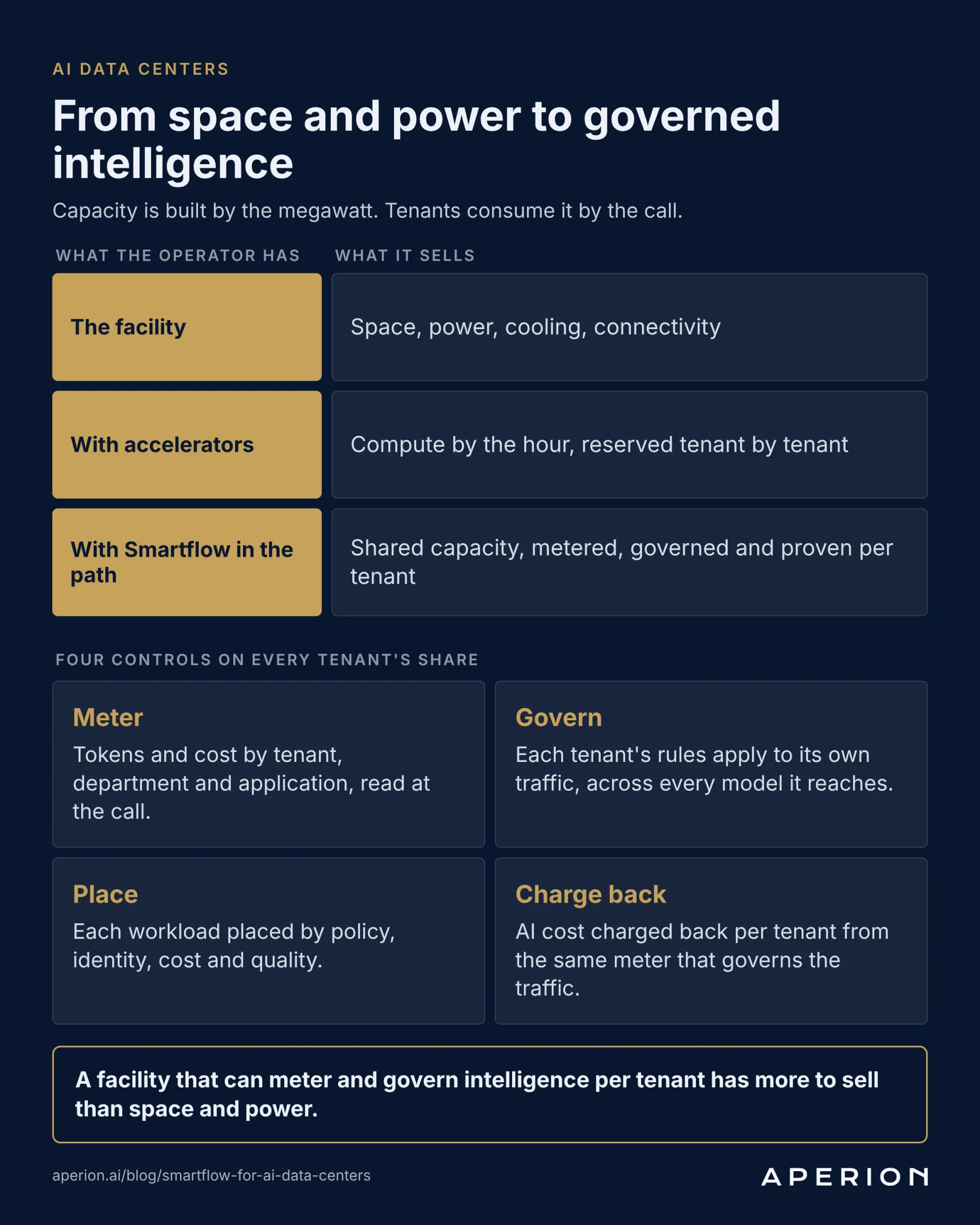
Capacity is built by the megawatt. Tenants consume it by the call.
- No meter at the call. The operator reads power draw and rack utilization. It cannot see which tenant sent which workload to which model, or what that work cost.
- No policy per tenant. Tenants share accelerators and models. With no control in the path, each tenant's rules and data boundaries exist in the contract and nowhere in the traffic.
- No proof. A regulated tenant has to show who authorized an action and where it ran. Infrastructure logs show that a machine was busy.
Repeat work runs twice. With no cache in the path, every repeated question is new inference, new power and new heat.
One control point between tenants and models
Smartflow sits in the path between each tenant's applications and agents and every model they call, on the facility's hardware or outside it. Identity and access stay where they are.
- Identity proofing is the tenant's own. Smartflow reads it and does not replace it.
- Access governance is the tenant's own. Entitlement is resolved at the call from the tenant's directory.
- Runtime governance is APERION's. Every call is checked against its tenant's policy and placed on a model.
- Audit and evidence is APERION's. The record proves who decided and writes to the existing SIEM.
Four controls on every tenant's share
- Meter. Tokens and cost by tenant, department and application, read at the call.
- Govern. Each tenant's rules apply to its own traffic, across every model it reaches.
- Place. Each workload is placed by policy, identity, cost and quality. A model swaps or fails over without a change to the application.
- Charge back. AI cost is charged back per tenant from the same meter that governs the traffic.
A tenant can be a customer, a brand, a franchise or a department.
Repeat work needs no new inference
Smartflow answers repeat work from a semantic cache and compresses what it sends on. Work the cache answers is work the accelerators do not run again. How much capacity that returns to each tenant depends on the workload, and it is the first thing a proof of concept measures.
Inside the facility by design
Smartflow runs as a compiled binary on the facility's own cluster. Requests, prompts, responses and cached artifacts stay off APERION infrastructure. It deploys three ways:
- On-premises data center with zero external network egress
- Private VPC
- Air-gapped sovereign, with offline builds and signed updates
It is designed to run the control path inside the customer-controlled environment in the United States, the European Union, Saudi Arabia, mainland China and other regulated markets. Common policy definitions can travel. Enforcement, credentials, governed traffic and required evidence stay inside the regional boundary.
Global policy. Local enforcement. Portable evidence.
From space and power to governed intelligence
| What the operator has | What it sells |
|---|---|
| The facility | Space, power, cooling, connectivity |
| With accelerators | Compute by the hour, reserved tenant by tenant |
| With Smartflow in the path | Shared capacity, metered, governed and proven per tenant |
The first two are sold on a rate card. The third is a service a regulated tenant can put production work on. A facility that can meter and govern intelligence per tenant has more to sell than space and power.
How it starts: one facility, one set of tenants
- Choose the facility and the tenants.
- Smartflow watches their live traffic and meters it by tenant.
- The proof of concept is scoped from those numbers: policy, cache and chargeback switched on for a chosen set of tenants, on their own workloads.
Production follows on infrastructure the operator owns, sized from the proof of concept. Then the next facility.
Why the timing matters
The hardware is committed for years. The demand arrives by the call. Whose balance sheet carries AI capex? sets out what that gap means for whoever owns the asset. An operator that can meter, govern and prove each tenant's share has a way to fill the capacity it has already paid for.
A verified person, the authority that person delegated, the agent that used it, the policy that applied, the decision and the record of all of it. That chain is the product.
Talk to APERION about one facility and one set of tenants.

Put this in the path of your own agents.
Policy enforced inline between your agents and every model and tool they reach, with a record bound to the human who owns it.
Request a Demo Read the docs