
On Thursday, November 19, the Dow fell 1,101 points. The reason given was the one the market has given all month: doubt that AI spending can last.
The debate runs on one number, total spend. Two questions sit under it: how much capacity the work needs, and who pays to build it.
Capex follows workloads
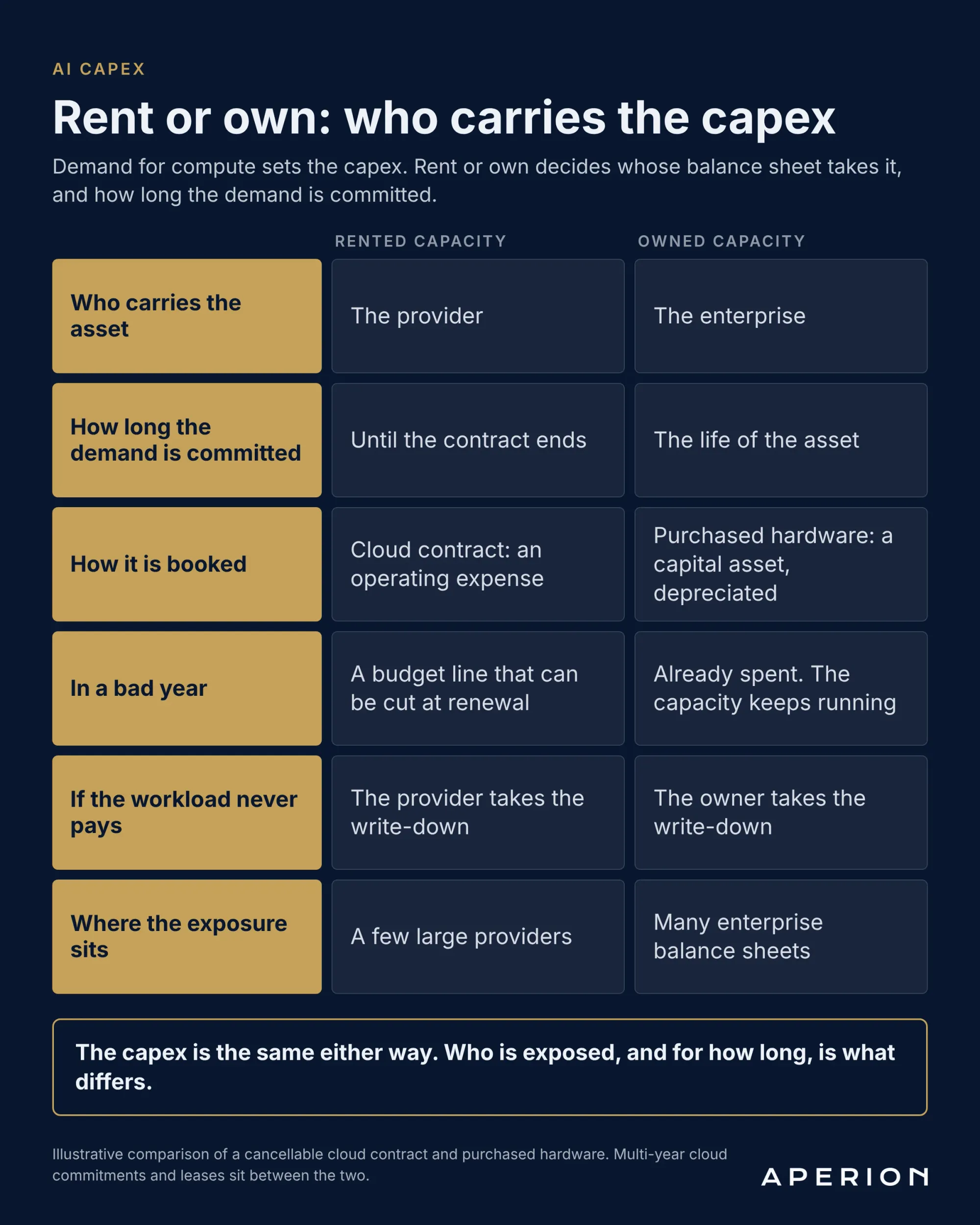
If the workloads exist, someone pays for the chips, the building and the power. Renting capacity puts that cost on a provider's balance sheet. Owning it puts the cost on the enterprise's. The capex is there either way.
Rent or own sets the one variable the market is short of: how long the demand is committed.
Rented demand can leave
A rented GPU hour can be cancelled. The provider carries a multi-year asset against demand that can leave when the contract ends. Alphabet's third-quarter results, reported October 28, showed negative free cash flow of $9.1 billion, its second negative quarter in a row, as it built capacity ahead of that demand.
Multi-year cloud commitments exist, and they narrow the gap. Capacity sold by the hour or the month stays exposed.
Owned demand is on the record
An enterprise that buys the hardware, signs the lease and contracts the power has made a commitment nobody can cancel. The supplier is paid. The demand is on the record for the life of the asset.
The accounting follows. A cloud contract is an operating expense, and operating expenses get cut at renewal when a year turns bad. Purchased hardware is a capital asset. The money is spent, the depreciation runs either way, and the capacity gets used.
The risk stays
If the workload never pays, the write-down lands on the owner instead of the provider. Ownership moves the risk and fixes its term.
Right now that exposure sits with five companies, and the market reprices all of it every time one of them misses a quarter. Spread across a few thousand enterprise balance sheets, each backing workloads it runs itself, the same capex is a different kind of risk.
What to read at the next earnings
Check the backlog alongside the capex number: how much is under contract, and for how many years. Companies report it in the notes to their financial statements as remaining performance obligations. That tells you whether the spending is backed.
The balance sheet is one question. Control is another.
Rent or own settles who carries the asset. It leaves open who controls the work that runs on it.
An enterprise can rent every model it uses and still own the point where each call is checked, metered and recorded. Enterprises will rent some intelligence and own more of it. The control point sits in the path between agents and every model and tool they call, rented or owned, and keeps each action inside the authority a person delegated.
Related reading: Rent or own AI workloads and the hybrid AI estate guide.
For the facilities that host owned capacity, see Smartflow for AI Data Centers.
Sources
- Dow Jones Industrial Average, November 19, 2026: Asianet Newsable, citing CBS News
- Alphabet third-quarter 2026 free cash flow: PYMNTS, November 9, 2026
- The five largest AI capital spenders: Tech Insider, citing Fortune's tally
Market figures verified as of November 20, 2026. Nothing here is investment advice.

Put this in the path of your own agents.
Policy enforced inline between your agents and every model and tool they reach, with a record bound to the human who owns it.
Request a Demo Read the docs