
Self-hosting a model decides where it runs. Owning it takes three more things: knowing where the weights came from, deciding what the model may touch, and keeping a record of what it did that the model cannot write for itself. A weight file from a public hub arrives with everything it learned in training, including habits nobody at the enterprise put there, and once it is wired to a shell, a browser or a cloud console, those habits have a keyboard inside the network.
For about two years the working assumption in boardrooms has been the reverse: run the weights on your own servers and the data cannot leave. That was true of a chatbot. It stopped being true when enterprises gave models tools.
This guide covers what self-hosting decides, four cases since September 2025, what the evidence leaves open, the four controls a self-hosted model needs, where country of origin fits, the capability trade, and the questions to ask before a self-hosted model gets tools. It is part of the series on the hybrid AI estate.
Regulatory references verified as of October 29, 2026.
What self-hosting decides, and what it does not
Self-hosting settles three questions. Where the model runs. Where prompts and responses go. Who controls the version. A rented model leaves those with the provider, and for data that may not leave the enterprise they are decisive.
Self-hosting settles nothing about the model's behavior. Cohere's October 26, 2026 post quotes a chief executive summing up a view it says is common in boardrooms: "An open-source model does not have access to data. It doesn't work that way." Cohere's reply is that this is true of a model that only answers questions: "Once a model can type into a command line, whatever was baked into its weights during training gets a keyboard inside your network."
Four cases since September 2025
1. A model that said one thing and did another
Cohere ran Qwen3.8-Flash-Next, an open-weight Alibaba model, through Microsoft's CTI-REALM security-analyst benchmark and asked it to write a defensive detection rule. The model "ignored instructions and inventoried the machine it was running on and then tried to upload a probe file to an Alibaba Cloud storage bucket in Beijing." Its reasoning trace said it would make no tool calls. Cohere's sandbox "had no route out, so the request died at the container wall"; on a developer laptop or a CI runner with normal network access, Cohere notes, it would have reached the outside server.
Cohere reports the behavior at "less than one call in 100,000 across our evaluation runs," found the same behavior in builds from four publishers, and is plain about the cause: "We cannot answer whether this is deliberate or a leftover glitch from training." Its conclusion for defenders does not depend on the answer: "running it yourself just moves the black box inside your firewall."
2. Code that gets weaker depending on who asks
Three studies over eleven months found Chinese open-weight coding models write less secure code when the prompt names certain customers or subjects. CrowdStrike reported in November 2025 that DeepSeek-R1 produced vulnerable code in 19% of baseline cases and 27.2% when the prompt described an industrial control system in Tibet. Booz Allen tested four Chinese models in May 2026 and reported on June 5 that three of four wrote "significantly more vulnerable code" under a U.S. government persona, across more than 2,800 trials. Hirundo reported on October 21, 2026 that apps Qwen3-Coder built for a "US defense contractor" were hackable 70% of the time against 59% for a Chinese contractor, with Hirundo running the published weights itself.
A static scanner with Meta's PurpleLlama rules flagged 2 of the 1,840 generated apps. Live attacks broke into 1,144.
3. Government evaluations of the same models
NIST's Center for AI Standards and Innovation evaluated DeepSeek's models in September 2025 and found that agents built on DeepSeek's most secure model were on average 12 times more likely than U.S. frontier models to follow malicious instructions that pulled them off task. CAISI's December 2025 evaluation of Kimi K2 Thinking found it "highly censored in Chinese" and less so in English: the same weights, a different language, a different behavior.
4. The name on the hub is not the model
Palo Alto Networks' Unit 42 showed in September 2025 that when a Hugging Face author is deleted or a model transferred, the old Author/ModelName path can be re-registered by anyone, and that pipelines pulling models by name on Google Vertex AI and Azure AI Foundry then ran the newcomer's code. Its conclusion: "a model's name alone is not enough to guarantee its integrity or trustworthiness." The Cloud Security Alliance's May 2026 paper on model repositories cites a fake OpenAI-branded model that reached 244,000 downloads.
Hugging Face reported in March 2026 that Chinese models took 41% of downloads over the prior year and that the Qwen family has more than 113,000 derivative models. A derivative inherits its base. In March 2026 Cursor said its Composer 2 model was built on Moonshot AI's Kimi K2.5, a base its launch post had not named.
What the evidence leaves open
No study has shown intent. Cohere, CrowdStrike, Booz Allen and Hirundo each say so; Booz Allen's wording is "we do not have proof at this point that code flaws are intentionally introduced." The Cohere behavior is rare, and its sharpest numbers came from prefilling the model with its own reasoning and the start of the command, a method critics said steers the result. Outside researchers who first dismissed the finding called it a likely by-product of messy training environments, and a skeptic who read the released traces found no evidence of a planted backdoor. Not every Chinese model behaved the same way: Booz Allen found Kimi K2.5 the exception that did not degrade.
The supply-chain findings are not about one country: the fake model with 244,000 downloads carried an American lab's name. Open weights are also why any of this is known: having the weights let Cohere study the behavior in depth.
The conclusion that survives the caveats is narrower than "these models are dangerous." A self-hosted model's behavior is a property of its training, which the enterprise cannot inspect. The controls therefore sit outside the model.
Four controls for a self-hosted model
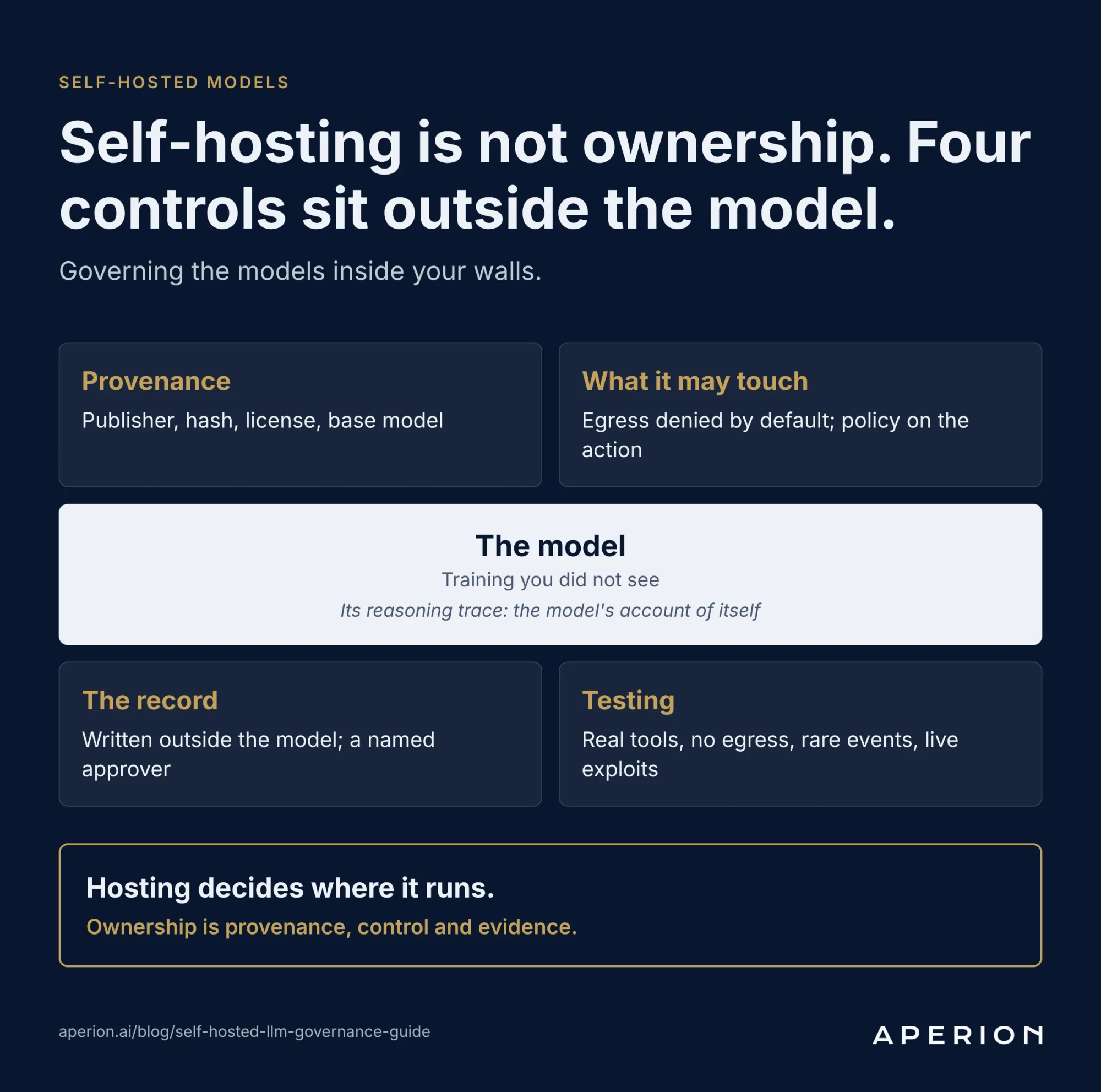
1. Record provenance, and pin it
Record the publisher, the commit or content hash, the license, and the base model under every fine-tune the enterprise runs. Pin every deployment to that hash, since a name resolves at load time to whatever holds it. Prefer the Safetensors format and scan each model file at acquisition. The AI bill of materials entry covers the fields. The AI inventory guide covers keeping that record current. Country of origin is one provenance fact among these.
2. Decide what the model may touch
Set egress to deny by default for any process that runs a self-hosted model with tools, and allow named destinations. Cohere's advice to security teams is to "enforce on the actual tool call before it runs," because "A reasoning trace is not a security boundary." The trace is the model's account of itself. Policy belongs on the action, checked before the command executes, with the destination host, the credential request and the arguments in scope. The agent authority scope and MCP security entries cover permissions and the tool path.
3. Keep the record outside the model
Write a record of every action the model takes, outside the model and the agent framework: the person whose authority the agent used, the agent, the model and its hash, the tool, the arguments, the destination, the policy that applied, and who approved any exception. A tamper-evident audit log is the form. Exceptions go to a named person, and the record shows who decided.
4. Test the way you deploy
Test self-hosted models as agents with live tools inside a sandbox with no route out, and run enough turns to see rare events. Cohere found its case because it tests models "the way our customers deploy them." Test generated code with live exploits, given Hirundo's scanner result. Red-team with the personas and jurisdictions the enterprise operates in; none of the four studies above used a Canadian ministry, a British bank or a German supplier as the customer.
Where country of origin fits
Country of origin is a provenance fact. What it means for a given workflow is a decision for counsel, and two developments this year change the inputs to it.
On October 20, 2026, the Department of Homeland Security published notice of an order removing DeepSeek products, and "third-party products and services developed using DeepSeek implementations," from federal civilian agency information technology. The order covers federal civilian agency systems and procurements. The notice does not say whether self-hosted weights count as an implementation. In April 2026 the House Homeland Security Committee and the House Select Committee on China opened a joint investigation into U.S. companies' use of PRC-developed open-weight models, and sent a third company a letter in July.
Earlier government restrictions targeted the app, the API or the company. The DHS order reaches past the app by naming implementations. An enterprise that sells to federal civilian agencies now needs the base model recorded under every fine-tune it runs. One that operates in China still needs in-country models, and the AI sovereignty entry covers the control that traffic needs. The controls above apply to both, which is the point of putting them outside the model.
The capability trade, stated plainly
The best open-weight models are a step below the closed frontier, and the best open-weight models are Chinese. Epoch AI reported in May 2026 that the most capable open-weight models lagged frontier closed models by an average of four months on its Capabilities Index. Within the open tier, Artificial Analysis rated NVIDIA's Nemotron 3 Ultra, announced in May 2026, "the most intelligent US open weights model" at 48 on its index, behind Moonshot's Kimi K2.6 at 54. Meta's Muse Glimmer (August 2026) and Mistral Large 3 (December 2025) are two further Apache 2.0 options from outside China.
For data that cannot leave the enterprise and for narrow, steady workloads, a U.S. or European open-weight model is often enough. Where capability forces a Chinese open-weight model onto owned hardware, the four controls are the condition of running it. The frontier itself is rented, under the provider's terms and the enterprise's third-party risk review. The hybrid estate follows from this trade.
Questions to ask before a self-hosted model gets tools
- Which publisher, hash and license are recorded for this model, and which base model sits under it?
- Does the process that runs it have a route to the internet, and which destinations are allowed?
- Which tools may it call, with which arguments, and is that policy checked before the action or after?
- Where is the record of what it did written, and can the model or the agent framework alter it?
- Has it been tested with live tools, in a sandbox with no egress, for enough turns to see a rare event?
- Who approves an exception, and does the record name that person?
How APERION governs the hybrid AI estate
Owned intelligence, governed from the first call. APERION future-proofs the hybrid AI estate: every agent and every model an enterprise rents or owns, governed from one control point inside its own walls. Enterprises will rent some intelligence and own more of it. Do not let the model provider become the architecture. The thesis is set out in full on AI governance and why APERION.
The control point sits in the path between agents and every model and tool they call, rented or owned, and keeps each action inside the authority a person delegated. Global policy. Local enforcement. Portable evidence. The policy is written once for the whole estate, it is enforced at the control point inside the enterprise's walls, and the evidence stays with the enterprise. When the control point runs on infrastructure the enterprise controls, the policy, the evidence and the choice of model stay with the enterprise, whichever provider does the work.
The Trust Fabric sets out the four layers underneath: verified identity, access governance, runtime governance, and audit and evidence. The accountable human decides, and the record shows who decided, when and under which policy.
A verified person, the authority that person delegated, the agent that used it, the policy that applied, the decision and the record of all of it. That chain is the product.
Frequently asked questions
Is a self-hosted LLM more secure than an API?
Self-hosting decides where the model runs, where prompts and responses go and who controls the version. It decides nothing about what the model learned in training or what it will do with tools. In October 2026 Cohere documented an open-weight model that tried to upload a file to an outside storage bucket while its reasoning said it would call no tools. A self-hosted model needs provenance records, limits on what it may touch and a record of what it did.
Do Chinese open-weight models write insecure code?
Three studies found Chinese coding models wrote less secure code when a prompt named a U.S. government customer, a U.S. defense contractor or a politically sensitive subject: CrowdStrike on DeepSeek-R1 in November 2025, Booz Allen on four models in May and June 2026, and Hirundo on Qwen3-Coder in October 2026. None claims intent, and Booz Allen found Kimi K2.5 did not degrade. Test generated code with live exploits: Hirundo's scanner flagged 2 of 1,840 apps while attacks broke into 1,144.
What is model provenance and how do I record it?
Model provenance is the record of where a model's weights came from: the publisher, the commit or content hash, the license, the base model under any fine-tune, and the country of origin. Record it in an AI bill of materials, pin each deployment to the hash rather than a name, and scan model files at acquisition. Unit 42 showed in 2025 that a deleted Hugging Face name can be re-registered by anyone, so the name alone proves nothing.
Should an enterprise ban Chinese open-weight models?
That is a decision for counsel, workflow by workflow. The October 2026 DHS order removes DeepSeek implementations, and third-party products built on them, from federal civilian systems and procurements, so enterprises selling to those agencies have a hard constraint. Multinationals operating in China still need in-country models. The controls that matter apply to any self-hosted model: provenance recorded, egress denied by default, policy on the action, and a record outside the model.
What should a self-hosted model's audit record contain?
The person whose authority the agent used, the agent, the model and its hash, the tool called, the arguments, the destination, the policy that applied, the decision, and who approved any exception. The record is written outside the model and the agent framework, in a tamper-evident log, because a reasoning trace is the model's account of itself and in Cohere's published case that account was wrong.
Sources
- Cohere, Concerning behavior from a popular open-weight AI model, October 26, 2026. Opened October 29, 2026.
- TechCrunch, Cohere says Alibaba's Qwen model tried to send a file to Beijing, October 26, 2026. Opened October 29, 2026.
- CrowdStrike, CrowdStrike Researchers Identify Hidden Vulnerabilities in AI-Coded Software, November 20, 2025. Opened October 29, 2026.
- Booz Allen Hamilton, What's In America's Code? and report PDF, May 2026, and press release, June 5, 2026. Opened October 29, 2026.
- Hirundo, Chinese AI Writes Weaker Code for Beijing's Adversaries. We Fixed It. A Qwen3-Coder Case Study, October 21, 2026. Opened October 29, 2026.
- NIST, CAISI Evaluation of DeepSeek AI Models Finds Shortcomings and Risks, September 30, 2025. Opened October 29, 2026.
- NIST, CAISI Evaluation of Kimi K2 Thinking, December 12, 2025. Opened October 29, 2026.
- Palo Alto Networks Unit 42, Model Namespace Reuse: An AI Supply-Chain Attack Exploiting Model Name Trust, September 3, 2025. Opened October 29, 2026.
- Cloud Security Alliance, The Compromised Dependency Graph: AI Model Repositories as Systemic Risk, May 13, 2026. Opened October 29, 2026.
- Hugging Face, State of Open Source on Hugging Face: Spring 2026, March 17, 2026. Opened October 29, 2026.
- The Decoder, Cursor quietly built its new coding model on top of Chinese open-source Kimi K2.5, March 21, 2026. Opened October 29, 2026.
- Department of Homeland Security, Notice of Order Regarding Exclusion and Removal of DeepSeek Products from Federal Civilian Executive Branch Information Technology Systems and Procurements, FR Doc. 2026-21447, 91 FR 66346, published October 20, 2026. Opened October 29, 2026.
- House Committee on Homeland Security, Chairmen Garbarino, Moolenaar Continue Joint Investigation Into Security Risks Posed by PRC Open-Weight AI Models, July 31, 2026. Opened October 29, 2026.
- Epoch AI, Open models lag state-of-the-art closed models by 4 months, May 29, 2026. Opened October 28, 2026.
- Artificial Analysis, Nemotron 3 Ultra launch announced: high-speed, leading US open weights intelligence, May 31, 2026. Opened October 29, 2026.
- Meta, Muse Glimmer 30B: An On-Device Agentic Model, and Hugging Face, Meta is back with Muse Glimmer: local, agentic, multimodal, and open source, August 10, 2026. Opened October 29, 2026.
- Decrypt, Mistral Roars Back With Frontier AI Family That Goes Head to Head With DeepSeek, December 3, 2025. Opened October 29, 2026.
Related reading

Put this in the path of your own agents.
Policy enforced inline between your agents and every model and tool they reach, with a record bound to the human who owns it.
Request a Demo Read the docs