
Insurers will rent some intelligence and own more of it.
The volume work in claims, underwriting and service is routine: classifying a first notice of loss, extracting fields from an ACORD form, summarizing a medical record, drafting a coverage letter. That work can run on models the insurer hosts inside its own perimeter. Frontier models, rented by the call, take the novel reasoning. A single claim triage can touch a dozen model calls across both.
Every one of those calls feeds a regulated decision. Claims, underwriting and service are the work agents are good at, and the work an examiner reads. The examiner reads the decision and the record behind it, whichever model produced it. So the rules have to apply from the first call, rented or owned, in one place.
This piece covers what regulators now expect, why insurance makes ungoverned AI untenable, and where the human decision sits. The patterns are product-agnostic. A short note at the end maps them to what APERION ships.
1. What regulators now expect
Verified as of October 26, 2026. In most major markets, AI governance for insurers is now written down, and the requirements rhyme.
European Union
The EU AI Act lists AI used for risk assessment and pricing of natural persons in life and health insurance as high-risk. Under the amendment adopted in July 2026, those obligations apply from December 2, 2027: risk management, data governance, logging, transparency, human oversight, accuracy and cybersecurity. Disclosure duties for systems that interact with people have applied since August 2, 2026. EIOPA's Opinion on AI governance and risk management, published in August 2025, sets supervisory expectations across the insurance lifecycle, for AI uses the Act does not classify as high-risk or prohibited.
United States
The NAIC Model Bulletin on insurers' use of AI systems, adopted in December 2023, had been adopted by 27 states, the District of Columbia and Puerto Rico as of October 2026. It expects a written AI systems program, lifecycle governance and accountability for third-party AI. Colorado's SB21-169 regime requires insurers that use external consumer data, algorithms and predictive models to maintain governance and test for unfairly discriminatory outcomes. Its rules now cover life insurance, private passenger auto and health benefit plans. NYDFS Circular Letter No. 7, issued in July 2024, sets expectations for AI and external data in underwriting and pricing, including board-level governance.
United Kingdom, Canada and Asia-Pacific
The FCA's Consumer Duty reaches algorithmic decisions that affect customer outcomes. OSFI's Guideline E-23 brings model risk management, with specific expectations for AI and machine learning, to federally regulated insurers from May 1, 2027. Singapore's MAS FEAT principles set fairness and explainability expectations.
The details differ. The demands converge on five things:
- Accountability for every AI system, including ones bought from vendors. "The model came from a third party" is a defense nowhere.
- Fairness testing, especially for proxy discrimination in underwriting and pricing.
- Explainability and documentation of how AI participates in decisions.
- Human oversight of consequential decisions, with authority to intervene.
- Auditability: records that survive a market-conduct exam or a regulator's data call.
Each of those five demands is an architecture requirement. A policy PDF satisfies none of them. A control point that enforces and records on every call produces the enforcement and the evidence each of the five asks for.
2. Why insurance makes ungoverned AI untenable
Nearly all the data is sensitive
Claims files contain medical records, police reports, financial details and photographs of the worst day of someone's life. Sending that to a third-party model endpoint is a decision with consequences, and in some jurisdictions it is not a permitted one.
Adverse decisions carry legal weight
A claim denial, a nonrenewal, a rated-up premium: regulated outcomes with notice requirements and appeal rights. An agent that drafts or influences one is participating in a decision the insurer must defend, sometimes years later.
Old cores, many integrations
Policy administration, claims platforms, rating engines, actuarial models and a thick web of third-party data vendors. Point-to-point AI integrations into that estate multiply risk, with no single place to see, control or prove what the AI did.
Shadow AI is already inside
Adjusters and underwriters paste claim narratives into public chatbots wherever no sanctioned alternative exists. AI already touches the book of business. The open question is whether it does so through a governed path.
3. One control point for every call
The structural answer is one control point that every agent, model, data source and vendor tool passes through. Rented models and owned models, internal agents and a vendor's tool, all connect through it, and nothing connects around it. It does six jobs.
- Access. One governed path, deny by default, whether a request comes from an internal agent or a vendor's tool.
- Identity. Every agent acts for a named person. This claims agent acts on behalf of this named adjuster, under this authority, and the binding travels into the record on every request.
- Policy. Enforced inline, at runtime. Data-class rules live here: what may leave the perimeter, what must stay, and the information barriers between functions where they are required.
- Workflow. Multi-step work with approvals built in. A claims workflow stops before an adverse action because the workflow requires it, and the stop is recorded.
- Catalog. A vetted list of the tools, data sources and vendor integrations agents may use. Third-party data enters through catalog entries with contracts and controls attached.
- Evidence. A tamper-evident record of every decision, every input class and every human approval. It is the artifact the insurer hands an examiner, in place of six weeks assembling a data call by hand.
The distinction that matters most in insurance is enforcement at runtime. A fairness policy checked quarterly cannot reach a decision in the moment. A control point on the request path can send the adverse action to the accountable human before it happens, and record what the model saw.
4. Rent some, own more
Because every model call passes through the one control point, policy selects the model that serves each request, on the data class, the task type and the cost. No extra model sits in the path to choose.
Most insurance AI traffic is routine and high-volume, and it does not need a frontier model. It can run on small, specialized open-weight models the insurer hosts inside its perimeter, while frontier models keep the novel reasoning. The rule lives in policy, so a path that ends in an adverse action can stay pinned to a frontier model and a human decision.
Cost you can attribute
Every call passes one path, so spend is attributable per team, per workflow and per product line, with caps, quotas and routing rules in policy rather than in each application's code.
Cheaper on the routine
Routine work is most of the volume. Serving it from a small local model cuts the cost of that work and decouples the insurer's unit economics from a provider's pricing decisions.
Caching
Repeated questions over the same policy language or claim documents are served from cache instead of being billed again.
Inside the perimeter
Owned models run inside the insurer's perimeter. Policy can keep requests that carry medical records, claim files or underwriting data on a local model, so the data-transfer question becomes a routing rule an examiner can read.
Owned, and replaceable
The insurer selects, hosts and replaces the models that serve each lane. Changing one is a policy setting. The agents above it do not change.
The controls stay the same whichever model answers. The access rules, the identity binding, the policy checks and the record apply to a frontier model and a local one alike.
5. The adverse-action decision stays human
Regulators in most of the markets above converge on one requirement: consequential decisions need accountable human oversight. For insurance the pattern is precise.
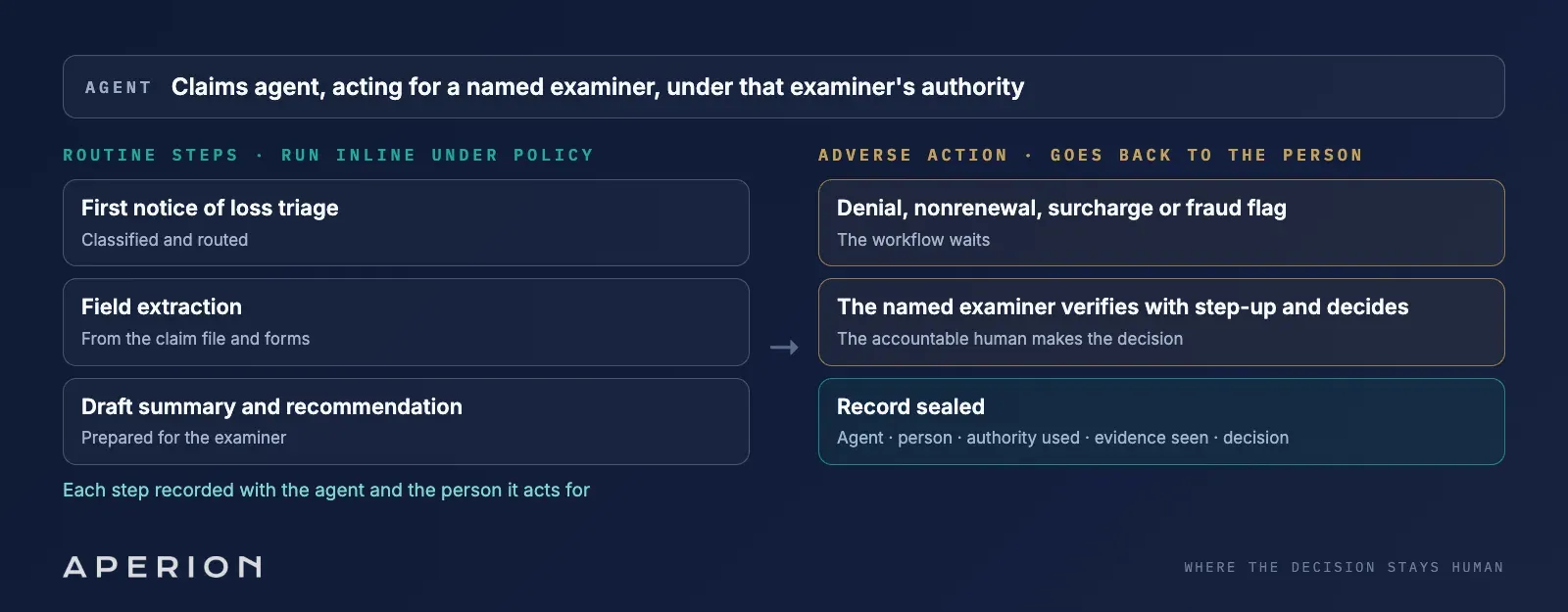
- Routine work runs at machine speed. Summaries, lookups, drafts and classifications run without a stop. When a workflow reaches an adverse action, such as denying a claim, nonrenewing a policy, applying a surcharge or flagging suspected fraud, it goes back to the accountable examiner, who decides. The workflow waits for that decision.
- Verified means verified. The examiner's identity is established through identity proofing and step-up authentication, rather than a shared queue and a button anyone could press. The decision, the person who made it and the evidence they saw go into the record.
- Every agent acts for a named person. "The system denied the claim" is never the answer. "This agent, acting for this named examiner, prepared the recommendation, and this verified examiner decided under this authority" is an answer that survives a market-conduct exam.
One pattern, many regimes. It lines up with the EU AI Act's human-oversight requirements, the NAIC bulletin's accountability expectations, Colorado's governance requirements and the FCA's outcome duties at once. Build it once at the control point, and every workflow inherits it.
6. The operating model
Clear ownership
Someone owns the control point as a product. Someone owns the catalog and the standards for publishing into it. Someone owns the adverse-action decision queues. Insurance has a natural ally here: model-risk and actuarial governance functions already know how to own model inventories, and the control point gives them a live one.
Compliance mapped to controls
A control point that enforces at runtime and produces evidence maps directly onto the regimes insurers answer to.
| Regime | What it expects | What the control point provides |
|---|---|---|
| EU AI Act (life and health pricing is high-risk from December 2, 2027) | Risk management, logging, human oversight, data governance | Runtime policy, a tamper-evident record, verified human decisions |
| NAIC AI Model Bulletin | Written AI systems program, lifecycle governance, vendor accountability | The catalog is the AI inventory, and vendor tools enter only through governed entries |
| Colorado SB21-169 | Governance and testing for unfairly discriminatory outcomes | One path for all model traffic makes outcome testing and evidence collection practical |
| NYDFS Circular Letter No. 7 | Board-level governance, third-party oversight | Per-workflow evidence and attribution, exportable on demand |
| FCA Consumer Duty, MAS FEAT | Fair customer outcomes, explainability | Decision records with inputs, model identity and human decisions attached |
| OSFI Guideline E-23 (from May 1, 2027) | Model inventory and lifecycle risk management, AI and machine learning included | A record of which model served each request, owned or rented |
A repeatable model
The first deployment is the hard one, because the control point has to be stood up. Every agent, line of business and vendor integration after that is a composition problem inside controls that already exist. That is how insurance AI moves from a series of pilots to an operating capability with a record the insurer can defend.
Where APERION fits
None of the patterns above requires a specific vendor: one governed path, every agent acting for a named person, a vetted catalog, enforcement at runtime, a tamper-evident record, and policy routing between rented and owned models. Any serious insurance AI program will converge on them, because the regulations already have.
This is what APERION builds. Smartflow, its on-premises control plane, sits in the call path between agents and models. It enforces policy inline at every prompt, response and MCP tool call. It binds each agent action to the person whose authority the agent is using and records evidence a regulator can examine. When an agent exceeds the authority it was given, the action goes back to that person, who decides live.
In production with a global insurance and financial-services leader. Currently scoping a limited set of runtime-governance design partners across regulated industries.
The examiner, the authority, the action, the record. That chain is the product.
Regulatory summaries are general and current as of October 26, 2026. They are not legal advice. Confirm requirements with counsel in each jurisdiction.

Put this in the path of your own agents.
Policy enforced inline between your agents and every model and tool they reach, with a record bound to the human who owns it.
Request a Demo Read the docs