
Enterprise AI traffic makes an attractive training set, and every response in it was produced under the entitlements of the person who asked. Train one model on all of it and that model can answer one user with what another user alone was entitled to see. To fine-tune safely, label every record with the permission boundary it was created under, train one specialist per boundary inside your own environment, test it for leakage as well as accuracy, and serve it to a requester when that requester's authority covers the boundary it learned from.
Why enterprise AI traffic is a tempting training set
Enterprises send the same kinds of work to frontier models over and over: classifying claims, summarizing contracts, drafting answers to routine requests. Each exchange is a labeled example. The request is the input, the response is a candidate label, and the user's next action shows whether the answer was any good.
Fine-tuning a smaller model on that record is an obvious move, and parameter-efficient methods make it cheap. Low-rank adaptation (LoRA) trains a small set of added weights on a frozen base model. Its authors report that, compared with fully fine-tuning a 175-billion-parameter model, it reduces trainable parameters by 10,000 times and GPU memory by 3 times, with quality on par with or better than full fine-tuning on the models they tested.
The traffic arrives as one stream. Each record in it was governed by who was allowed to see what.
How fine-tuning erases permission boundaries
When a deal-team banker asks an assistant about a client, the answer draws on documents the deal team alone may read. When an HR partner asks about a case, the answer draws on personnel files. At request time, entitlements, information barriers and data classification decided what each of those users could retrieve and what the model could return.
Training removes that context. A model learns from the examples it sees, with no memory of who was allowed to see them. Merge the deal team's traffic with everyone else's and the resulting model has absorbed content that most of its future users were never entitled to read.
The research shows that models can give that content back:
- Membership inference. Shokri and colleagues showed that an attacker with black-box query access can often tell whether a specific record was in a model's training set.
- Unintended memorization. Carlini and colleagues developed a testing method for measuring the risk that rare or unique training sequences are memorized by generative sequence models.
- Extraction. A 2020 study extracted hundreds of verbatim sequences from GPT-2, including names, phone numbers and email addresses, even though each sequence appeared in a single training document. A 2023 study extracted gigabytes of training data from open, semi-open and closed production models by querying them, and concluded that current alignment techniques do not eliminate memorization.
- Fine-tuning method. In their experiments, Mireshghallah and colleagues found fine-tuning a model's head alone the most susceptible to membership inference and extraction, and small adapters appeared less vulnerable to known extraction attacks.
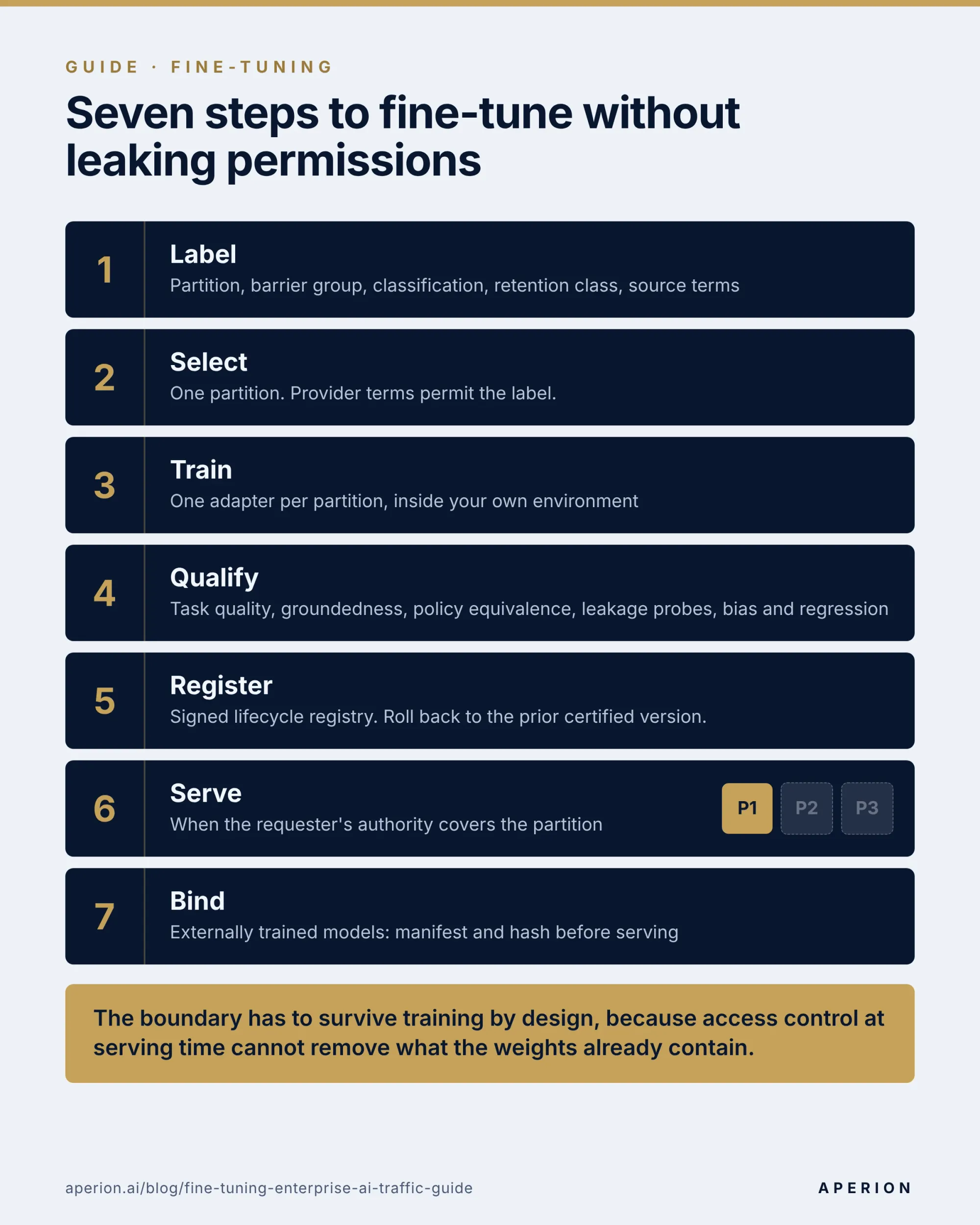
Fine-tuned specialists learn from smaller, more repetitive and more sensitive data than a pretraining corpus. The boundary has to survive training by design, because access control at serving time cannot remove what the weights already contain.
Step 1: Label every record with the boundary it was created under
Before any record becomes a training example, record the conditions under which it was produced. Tag it with five labels:
- Partition. Derived from the requester's entitlements at the time of the exchange: a business unit, a client matter, a deal team, a data room.
- Barrier group. Membership in any information barrier, such as research and banking, or two sides of a matter.
- Classification. The sensitivity of the content, from your data classification scheme.
- Retention class. How long the record may be kept.
- Source terms. Whether the terms of the model that produced the response permit using it as a training label, and whether the license of any retrieved content permits training on it.
Derive labels from the same identity and entitlement data that governed the request, at the time of the request.
Source terms deserve their own attention, because they vary by provider and change over time. As read on November 20, 2026, the business terms of three major model providers differ in substance. One bars using its services to build a competing product or service, including to train competing AI models (terms effective June 17, 2025). One bars using output to develop models that compete with its products and services, with exceptions for models primarily intended to categorize, classify or organize data that are not distributed or made commercially available to third parties, and for fine-tuning models provided as part of its services (the page shows no effective date). One bars using its services to develop models that compete with them, and separately restricts training on certain grounded search results and mapping data (last updated April 28, 2026). Each also states, in its own wording, that it does not use business or paid customers' content to train its models or improve its services.
Read the terms that govern your contracts, record the version you relied on, and have your lawyers make the call. Retrieved content needs the same review: a document license that allows reading may not allow training.
Step 2: Select examples for quality, inside one partition
Volume does not make a good training set. Score each candidate record on:
- Groundedness. Does the response agree with the sources that were retrieved for it?
- Outcome. Was the answer accepted, edited, re-requested or overridden?
- Novelty. Does it add coverage the set lacks, or repeat examples already present?
- Fit. Does it match the format and context length of the target model?
Then apply two eligibility rules without exception. A specialist designated for a partition trains on records labeled with that partition and nothing else. A response from an external provider becomes a training label where that provider's terms permit; otherwise the record is dropped or relabeled by a model the enterprise hosts.
One more check before you trust the set: compare what providers bill you for with what your AI gateway metered. A gap means traffic bypassed the governed path, and a training set drawn from the governed subset alone will misrepresent the work people do. The shadow AI guide covers finding that traffic.
Step 3: Train per partition, inside the enterprise
Run training on infrastructure you control: your data center, your cloud account, or a sovereign or air-gapped facility. Training data and resulting weights stay inside that boundary.
A practical pattern is one adapter per partition and workload class on a shared open-weight base model. The claims team's classification adapter and the legal team's summarization adapter share a base and nothing else. Open-weight bases carry their own licenses; review them alongside provider terms.
Step 4: Qualify on more than accuracy
Accuracy tells you whether the specialist does the task. It says nothing about whether the specialist obeys your policy or keeps your confidences. Qualify every candidate on five tests.
| Test | What it checks | How to run it |
|---|---|---|
| Task quality | The specialist performs the task as well as the model it replaces | Score a held-out replay of recorded requests and compare with the teacher |
| Groundedness | Answers agree with retrieved sources | Check responses against the documents retrieved for each request |
| Policy equivalence | The specialist triggers the same policy outcomes as the governed path | Apply the same policy bundle to both outputs on a policy test set; allow, redact and block outcomes must match |
| Leakage probes | The specialist does not reproduce data from outside its partition | Plant unique marker records in other partitions and confirm they never appear; run membership-inference and extraction tests; test for regurgitation of redacted personal data |
| Bias and regression | Behavior does not drift on cases your experts care about | Score golden sets maintained by domain experts |
Planted markers give the clearest leakage result because you know the ground truth. A marker that should be unreachable either appears in output or it does not. Membership-inference results need more care. A 2024 evaluation found that attacks on large pretrained language models barely beat random guessing in most settings, and that apparent successes were largely explained by distribution shift between members and non-members. Use markers as the primary test and inference attacks as a supplement.
Step 5: Keep a signed lifecycle registry
Every model version needs a record that answers four questions: what data trained it, under what configuration, what tests it passed, and who certified it. Store that record in a signed inventory with provenance down to partitions, record ranges and the consent under which records were collected.
Make deployment depend on a passing certificate. When a regression, a compliance event or a safety flag appears, roll back to the prior certified version. Archive retired versions with their provenance.
Step 6: Serve each specialist within its partition
A qualified specialist becomes one more inference source, with a scope equal to its partition. Compute effective authority on every request, from the person's current entitlements and what they delegated. The agent authority scope entry covers how delegated limits are written. Route to a specialist when that authority covers its partition, and to no specialist whose partition it does not cover.
When a person leaves the deal team, the next request should no longer reach the deal-team specialist, without waiting for a nightly sync.
Promote in stages. Run the specialist in shadow on mirrored requests with its responses withheld, compare it with the current source, open a bounded canary, then promote. Make it the default for a workload class after a held-out replay shows it outperforming the teacher.
Step 7: Bind externally trained models to what they learned from
Some enterprises use a separate training system, built in-house or supplied by a vendor, running in their own environment. The same rules apply, with two additions.
Export one partition at a time. Each export carries a manifest listing the partition, the record ranges, the labels, the source-terms determinations, the consent basis and a hash of the content. Grant the training system read access to that export for that job and no other. Because the export contains one partition, the partition rule is met whatever weighting the trainer applies inside it.
When the model comes back, bind it to its manifest before it can serve. Hash the returned model and record that hash against the export's manifest and the trainer's identity. Qualify it like any other candidate. Register it with the scope its manifest names. Refuse any model whose hash matches no certified entry, or whose manifest names records outside its partition.
Where APERION is headed on specialized models
Owned intelligence, governed from the first call. Enterprises will rent some intelligence and own more of it. APERION future-proofs the hybrid AI estate: every agent and every model an enterprise rents or owns, governed from one control point inside its own walls. The control point sits in the path between agents and every model and tool they call, rented or owned, and keeps each action inside the authority a person delegated.
On APERION's roadmap, a specialized model is designed to be trained, qualified and served within a single partition, and to answer a requester when that requester's authority, checked on that request, covers the partition. In that design, a model trained by a separate system would serve once it has been bound to the export manifest it learned from.
The Trust Fabric sets out the four layers underneath: verified identity, access governance, runtime governance, and audit and evidence. The hybrid AI estate guide covers renting and owning models side by side.
A verified person, the authority that person delegated, the agent that used it, the policy that applied, the decision and the record of all of it. That chain is the product.
Frequently asked questions
Can we fine-tune on our AI logs if we redact personal data first?
Redaction addresses personal data. Permissions are a separate problem. A record with every name removed can still contain a deal team's strategy or a client's confidential terms that most employees were never entitled to read. Replace personal data with typed placeholders, then partition by entitlement as well. Test for regurgitation of the placeholders too, because a model that reproduces redacted structure can still reveal more than intended.
Is LoRA safer than full fine-tuning for data leakage?
Research suggests lower exposure for adapters: in one study's experiments, fine-tuning a model's head alone was the most susceptible to membership inference and extraction, and small adapters apparently less vulnerable to known extraction attacks. Adapters still memorize. Partitioning is the control that keeps out-of-scope data out of the weights in the first place. Run leakage probes on every adapter, whatever method trained it.
What is a membership inference attack on an LLM?
It is a test of whether a given record was in a model's training data, run by querying the model and studying its responses. Shokri and colleagues described it against classifiers in 2016, and it has since been applied to language models. Results on large pretrained models are often near chance, so a failed attack is weak evidence of privacy. Planted marker records give a clearer answer for fine-tuned specialists.
Do model provider terms allow training on their outputs?
It depends on the provider and the version of the terms. As read on November 20, 2026, three major providers' business terms restrict using their services or outputs to build competing models, with differing scope and exceptions. Label each record with the terms that governed it, record the version you relied on, and let your lawyers decide. Where terms do not permit it, relabel with a model you host.
How is a specialist model different from a retrieval index?
A retrieval index looks documents up at request time, so access control can filter them per user. A specialist absorbs patterns from its training data into its weights, and per-user filtering at request time cannot remove what the weights already contain. That is why partitioning has to happen before training. A retrieval index can also be built per partition in place of a specialist, and the same partition rules apply.
Who should approve promoting a specialist into production?
The owner of the workload and the owner of the data partition, with evidence in hand: task quality on a held-out replay, policy equivalence, leakage probe results and bias checks. Promotion should require a signed certificate in the lifecycle registry, and rollback to the prior certified version should be one step. The accountable human decides, and the record shows who decided, when and under which policy.
Sources
- Shokri, R., Stronati, M., Song, C., and Shmatikov, V., Membership Inference Attacks against Machine Learning Models, arXiv:1610.05820, October 2016. Opened October 31, 2026.
- Carlini, N., Liu, C., Erlingsson, Ú., Kos, J., and Song, D., The Secret Sharer: Evaluating and Testing Unintended Memorization in Neural Networks, arXiv:1802.08232, February 2018. Opened October 31, 2026.
- Carlini, N., et al., Extracting Training Data from Large Language Models, arXiv:2012.07805, December 2020. Opened October 31, 2026.
- Nasr, M., et al., Scalable Extraction of Training Data from (Production) Language Models, arXiv:2311.17035, November 2023. Opened October 31, 2026.
- Mireshghallah, F., Uniyal, A., Wang, T., Evans, D., and Berg-Kirkpatrick, T., Memorization in NLP Fine-tuning Methods, arXiv:2205.12506, May 2022. Opened October 31, 2026.
- Duan, M., et al., Do Membership Inference Attacks Work on Large Language Models?, arXiv:2402.07841, February 2024. Opened October 31, 2026.
- Hu, E. J., et al., LoRA: Low-Rank Adaptation of Large Language Models, arXiv:2106.09685, June 2021. Opened October 31, 2026.
- Anthropic, Commercial Terms of Service, effective June 17, 2025. Opened November 20, 2026.
- OpenAI, Business Terms, no effective date shown. Opened November 20, 2026.
- Google, Gemini API Additional Terms of Service, last updated April 28, 2026. Opened November 20, 2026.
Related reading
- What Is a Hybrid AI Estate? Enterprise Guide
- Rent or Own: How to Decide Where Each AI Workload Runs
- How to Qualify a New AI Model Before It Takes Production Traffic
- What Is an AI Control Plane? The Enterprise Guide
- What Is an Enterprise AI Gateway? The Definitive Guide
- The Enterprise Guide to Shadow AI
- Third-Party Risk Management for AI Model Providers
- The Trust Fabric

Put this in the path of your own agents.
Policy enforced inline between your agents and every model and tool they reach, with a record bound to the human who owns it.
Request a Demo Read the docs