
Cost per successful workload is the expected cost of one outcome that passes its success test, counting every failed attempt and every fallback it took to get there. Price per token measures what a model charges; cost per successful workload measures what finished work costs. A cheap model that fails and falls back to a capable one can cost more per result than the capable model alone.
Why price per token misleads
Providers bill by the token, so finance teams compare models by the token. The comparison is easy and wrong in a specific way. It assumes every call produces usable work.
Calls fail. A structured extraction returns malformed JSON. A drafted letter cites a clause that is not in the policy document. A tool call arrives with an argument the downstream system rejects. A user reads the answer, rephrases the question and asks again. Each of those calls was billed. None of them finished the job.
When a call fails, something else happens next. The application retries the same model, falls back to a more capable one, or hands the work to a person. All three cost money. Price per token counts none of it.
The FinOps Foundation says unit economics "brings together what an organization spends on technology and the value that technology spending creates." For AI, the unit of value is a completed piece of work. The token is an input.
The definition, in words and in arithmetic
Pick a workload class: a category of request with a shared success test. Classify an incoming document. Extract fields from a form. Draft a letter grounded in policy documents. Answer a question from the knowledge base.
For one source and one class, two numbers matter: the cost of one attempt, and the probability that the attempt passes the success test.
If failures retry at the same source, cost per successful workload equals the cost per attempt divided by the probability of success. A call that costs one cent and succeeds half the time costs two cents per success.
If failures fall back to another source, cost per successful workload equals the cost of the first attempt, plus the failure rate times the expected cost of getting success through the fallback path.
From the second form comes a decision rule. Trying the cheap source first beats going straight to the fallback when the cheap attempt's cost is less than its success rate times the fallback's cost per success. Below that success rate, the cheap first attempt is a tax on every request.
A worked example
All figures in this example are illustrative. They describe no model, provider or deployment.
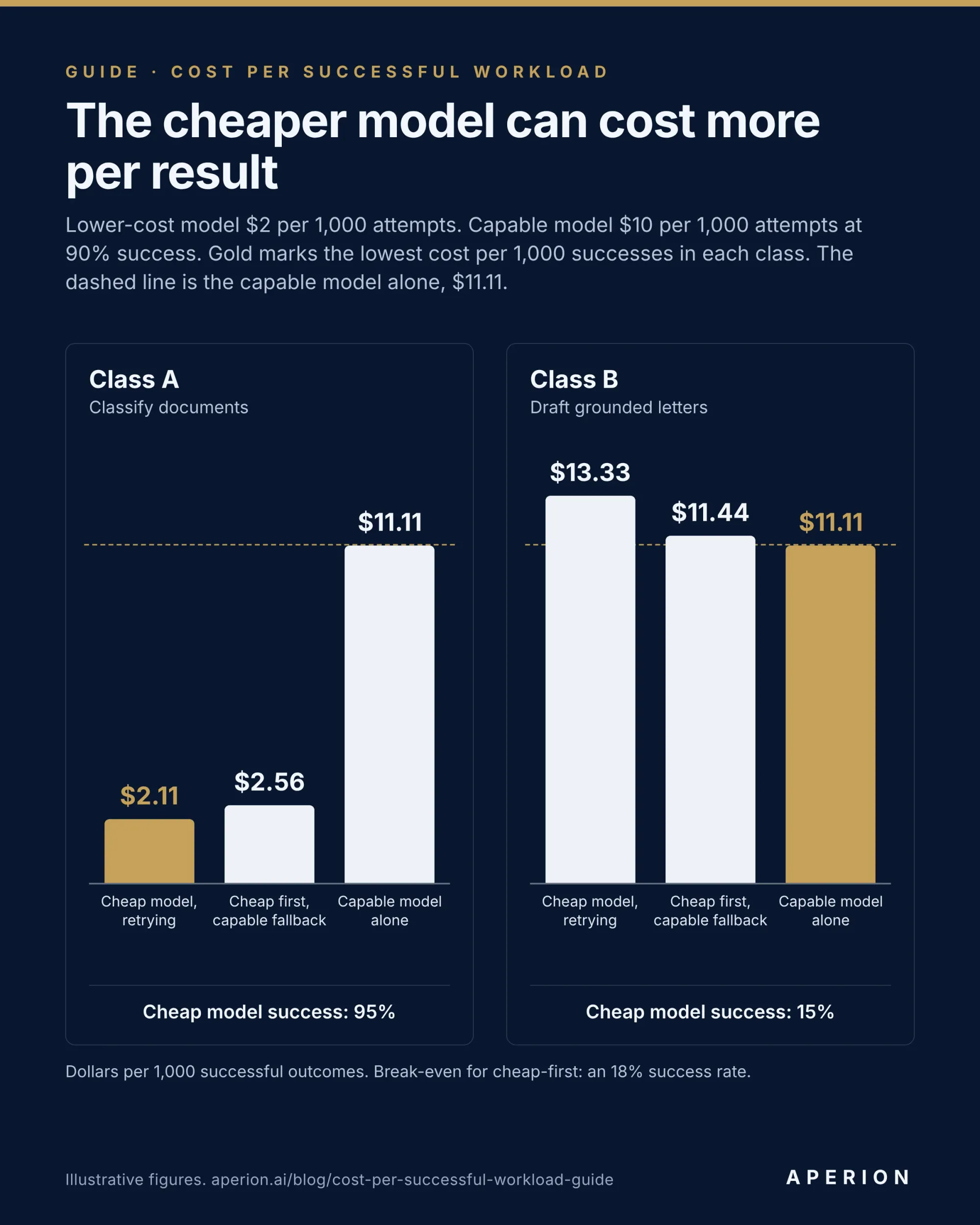
An enterprise runs two workload classes. It has a lower-cost model at $2 per 1,000 attempts and a more capable model at $10 per 1,000 attempts. The capable model passes the success test 90 percent of the time on both classes, so its cost per 1,000 successes is $10 ÷ 0.90 = $11.11.
Class A: classify incoming documents. The cheap model succeeds 95 percent of the time.
- Cheap model, retrying itself: $2 ÷ 0.95 = $2.11 per 1,000 successes.
- Cheap first, capable on failure: $2 + (0.05 × $11.11) = $2.56.
- Capable model alone: $11.11.
The cheap model wins by a wide margin. Price per token pointed the right way.
Class B: draft letters grounded in policy documents. The cheap model passes the groundedness check 15 percent of the time.
- Cheap model, retrying itself: $2 ÷ 0.15 = $13.33 per 1,000 successes.
- Cheap first, capable on failure: $2 + (0.85 × $11.11) = $11.44.
- Capable model alone: $11.11.
Here the capable model, five times the price per attempt, is the cheapest way to get a finished letter. The break-even for cheap-first is $2 ÷ $11.11, an 18 percent success rate. Class B sits below it.
| Workload class | Source strategy | Cost per 1,000 attempts | Success rate | Cost per 1,000 successes |
|---|---|---|---|---|
| A: classify documents | Cheap model, retries | $2.00 | 95% | $2.11 |
| A: classify documents | Cheap first, capable fallback | $2.00 first try | 95% then 90% | $2.56 |
| A: classify documents | Capable model alone | $10.00 | 90% | $11.11 |
| B: draft grounded letters | Cheap model, retries | $2.00 | 15% | $13.33 |
| B: draft grounded letters | Cheap first, capable fallback | $2.00 first try | 15% then 90% | $11.44 |
| B: draft grounded letters | Capable model alone | $10.00 | 90% | $11.11 |
All figures illustrative.
The example leaves out two costs that make the gap wider in practice. Every failed first attempt adds time before the user sees a result. And a failure that the validators miss reaches a person, who spends minutes correcting what the model got wrong.
How to judge success
A success test that is too loose makes the metric look better than the work. Define the test per workload class, write it down and run it on every outcome. Validators fall into four families.
- Schema checks. Structured output parses and matches the expected schema. Tool-call arguments are valid for the tool they target. These checks are cheap and deterministic, and they apply to most extraction and agent work.
- Groundedness. The answer is supported by the retrieved sources it was given. A drafted letter that cites a clause absent from the policy fails, however fluent it reads.
- Downstream acceptance. No person overrode the output or edited it beyond a set tolerance before it went on.
- No re-request. The requester did not send a near-duplicate request within a short window. A rephrased question is the user telling you the first answer failed.
Each response can also carry a quality score. Scores are useful for trends and for comparing sources. The success label is the binary verdict the arithmetic needs.
Keep validators out of the request path where they would add delay. Schema checks run inline. Groundedness and re-request signals can be computed after the response is served and attached to the record.
Track outcome and cost per workload class
Aggregate spend tells you how much was spent. The workload class tells you where the money produced work, so the class is the measurement unit.
For every request, record:
- the workload class and the requester;
- the source that served it, and every source it fell back to;
- tokens in and out, and the cost of each attempt;
- latency;
- validator results and the final success label.
With that record, cost per successful workload is a query: total cost for the class divided by successful outcomes for the class, per source. Run it weekly. Watch for classes where a source's success rate drifts down, because cost per success rises with it even when the price per token does not move.
The same records point to where to act first. A class with high volume, high external spend and an eligible lower-cost source is the first candidate to move.
Reconcile the bill against metered traffic
A cost metric built from metered traffic is blind to traffic that never passed through the meter. Teams call providers directly with a key from a side project. A vendor's embedded assistant bills the enterprise account. An agent framework ships with its own connector.
The check is simple. Take the provider's invoice for the period. Take the metered cost for the same provider and period from the control point. The difference is spend that bypassed the control point. Break it down by API key, project or account, and find the owner.
Run the reconciliation monthly at minimum. A persistent gap means the cost per successful workload figures understate true cost, and it means requests ran without the policy, the validators or the record.
Choose where each workload runs
Once success and cost are measured per class, placement becomes a decision with an answer. An enterprise in 2026 has four kinds of source:
- A response cache, which answers repeat work with no new inference.
- Enterprise-hosted models, open-weight models on the enterprise's own hardware or cloud account.
- Specialized models, small models trained for one workload class.
- External providers, frontier models in a provider's cloud.
Placement runs in two steps, in that order.
First, eligibility. Remove every source that policy forbids for this request. Residency: personal data that must stay in-region cannot go to an out-of-region endpoint. Handling: a provider's retention and logging terms must fit the data's classification. License: an open-weight model's terms must permit the use. Scope: a model trained on one business unit's data serves people entitled to that data and no one else. Policy decides this step, before cost enters the picture.
Second, selection. Among eligible sources, pick the one with the lowest cost per successful workload that meets the class's latency target. Respect budgets: a source at its daily budget cap is skipped, and a request that would breach a budget is capped or moved to a cheaper eligible source.
Authorization and placement belong in one decision with one record. The same context answers both questions: who is asking, on whose authority, what data is in the request, where that data may go, what the budget is and what kind of work this is. When the authorization layer and the router are separate systems, the router can pick a cheap external model for a request whose data was never allowed to leave the building. One decision record that shows who was authorized, which sources were eligible, which one was chosen and why gives finance and risk the same evidence.
The result is a mix. The cache handles repeats. A hosted or specialized model takes the high-volume classes it passes. External frontier models keep the novel and high-stakes work where their success rate earns their price. That is the hybrid estate described in our hybrid AI estate guide, with each part measured per workload class.
Questions to ask of any AI cost program
- Is each workload class defined, with a written success test?
- Does every request carry a class label, a cost and a success label?
- Do fallbacks and retries land on the same record as the first attempt?
- Does the provider invoice reconcile to metered traffic each month, and who owns the gap?
- Is placement filtered by policy before it is optimized for cost?
- Can one record show who was authorized, which sources were eligible and why one was chosen?
Where APERION fits
Owned intelligence, governed from the first call. Enterprises will rent some intelligence and own more of it. Hybrid today. Hybrid tomorrow. Sourced by workload. The unit that matters is cost per successful workload.
APERION future-proofs the hybrid AI estate: every agent and every model an enterprise rents or owns, governed from one control point inside its own walls. The control point sits in the path between agents and every model and tool they call, rented or owned, and keeps each action inside the authority a person delegated. The layer that checks whether an agent may act can also choose which model does the work, and both can land in one record.
Smartflow routes requests across providers with ordered fallback, chooses between a lower-cost tier and a more capable tier, caches repeat work, and reconciles metered spend against the billed figure the customer supplies, so calls that went around the control point show up. Cost per successful workload is the method those signals feed. Our enterprise AI gateway guide covers the control point itself.
The accountable human decides, and the record shows who decided, when and under which policy. The Trust Fabric sets out the four layers underneath: verified identity, access governance, runtime governance, and audit and evidence.
A verified person, the authority that person delegated, the agent that used it, the policy that applied, the decision and the record of all of it. That chain is the product.
Frequently asked questions
What is cost per successful workload?
Cost per successful workload is the expected cost of one outcome that passes its success test. It includes the first attempt, every retry and every fallback needed to reach a valid result. It is measured per workload class, such as document classification or letter drafting, because success rates differ sharply by class. It replaces price per token as the basis for choosing where AI work runs.
How is it different from cost per token?
Cost per token is a price. It tells you what a model charges for input and output. Cost per successful workload is a unit cost. It divides total spend, including failed attempts and fallbacks, by the number of outcomes that passed validation. A model can be five times cheaper per token and still cost more per finished task if it fails often enough.
How do you measure whether an AI workload succeeded?
Use validators matched to the workload class. Schema checks confirm structured output and tool-call arguments are valid. Groundedness checks confirm answers are supported by retrieved sources. Downstream acceptance confirms no person overrode or heavily edited the output. A re-request check confirms the user did not ask the same question again within a short window. Combine them into one success label per request.
When does a cheaper model save money?
A cheaper model saves money when its success rate on a workload class is high enough. The rule: trying the cheap model first beats going straight to the capable one when the cheap attempt's cost is less than its success rate multiplied by the capable model's cost per success. Classification and simple extraction can clear that bar. Grounded drafting may not. Measure it per class.
What is billed versus metered reconciliation?
It compares the provider's invoice with the cost the control point metered for the same provider and period. The difference is spend from calls that bypassed the control point, such as direct API keys or embedded vendor assistants. Those calls ran without policy, validators or a record. Reconciling monthly keeps the cost figures complete and surfaces ungoverned traffic.
Does cost per successful workload replace AI FinOps?
It works inside AI FinOps and gives it the right unit. Budgets, forecasts, chargeback and commitments still apply. Cost per successful workload tells finance which spend produced work, per class and per source, so optimization goes after failure and fallback cost and leaves productive usage alone. It fits the FinOps Foundation's framing of unit economics as spend tied to value created.
Sources
- FinOps Foundation, Capability: Unit Economics. Opened October 31, 2026.
Related reading

Put this in the path of your own agents.
Policy enforced inline between your agents and every model and tool they reach, with a record bound to the human who owns it.
Request a Demo Read the docs