The Routing Layer Gets Named From Three Directions
Three constituencies named the routing layer between May 4 and July 12: capital, the channel, and the developer mainstream. All three agree on the position. None includes identity, inline policy, or evidence.
Summary
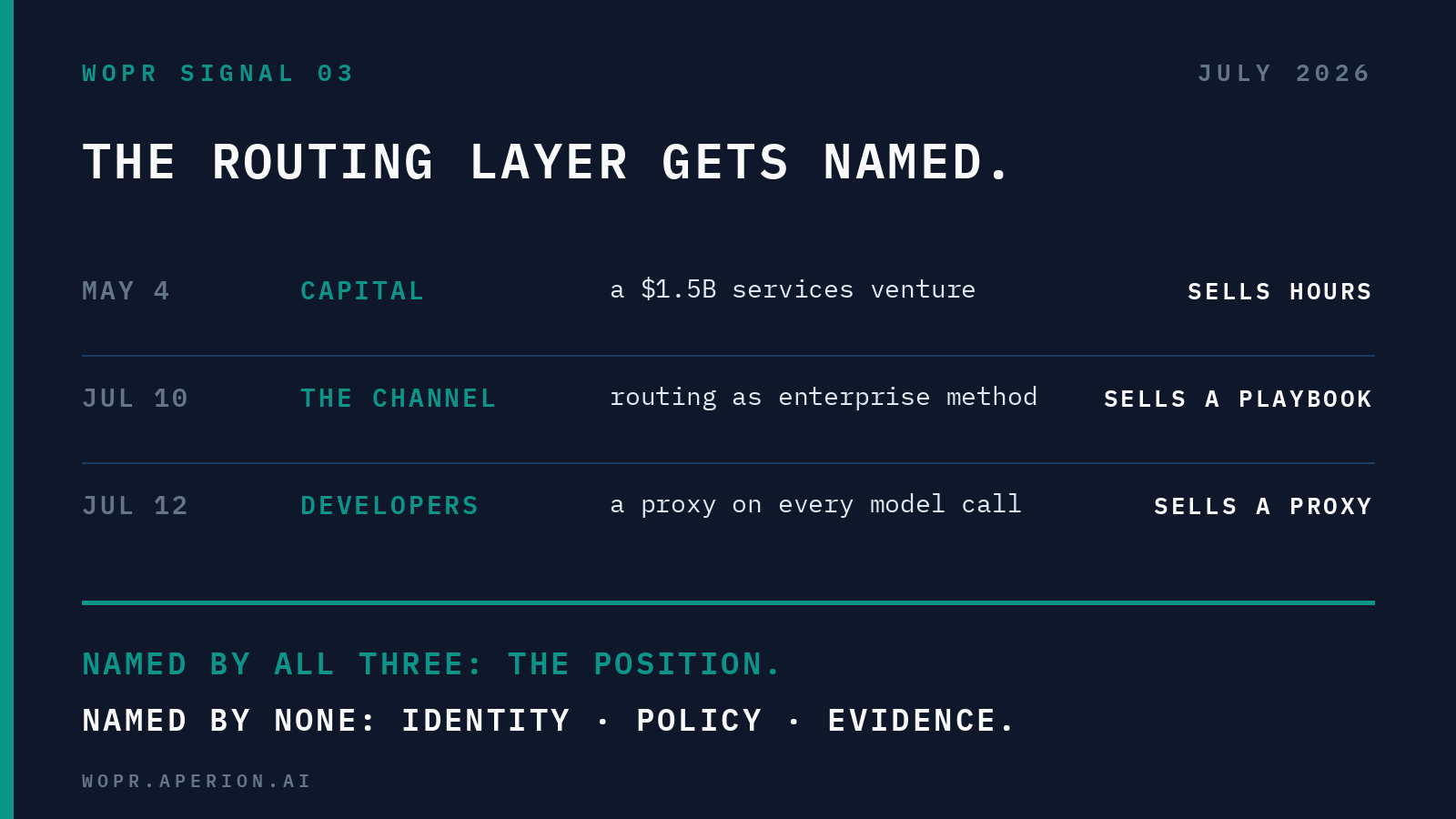
Between May 4 and July 12, 2026, three constituencies that rarely converge each put a name on the same architectural position: the control point between enterprise applications and the AI models they call. Capital named it a services business. The systems-integrator channel named it a methodology. The developer mainstream named it a proxy. The three namings agree on where the position sits. None of the three includes identity, inline policy, or durable evidence. The layer that makes routing governable remains unnamed by the parties now surrounding it.
Vector one: capital, May 4
Anthropic, Blackstone, Hellman & Friedman, and Goldman Sachs announced a standalone enterprise AI services firm on May 4, backed by roughly $1.5 billion in committed capital per the Wall Street Journal, with Apollo Global Management, General Atlantic, GIC, Leonard Green, and Sequoia Capital in the consortium. Hours earlier, Bloomberg reported OpenAI raising $4 billion at a $10 billion valuation for a near-identical venture. Fortune's coverage carried the ratio that explains both moves: for every dollar enterprises spend on software, roughly six go to services. The capital thesis is explicit. Deployment is the bottleneck, and value concentrates at the layer that makes models work inside a business. The chosen instrument is billable humans: forward-deployed engineers embedded in portfolio companies.
Vector two: the enterprise channel, July 10
Capgemini's Global Head of Agentic Scale published a widely engaged position on enterprise AI cost on July 10. Its vocabulary: tiered intelligence, dynamic model routing described as cache, route, validate, escalate, and a measurement standard of cost per successful outcome rather than cost per token. Its architectural prescription is an enterprise agentic harness that standardizes how context, tools, guardrails, security, and policy are applied to what teams build. The channel names the layer as method: something an organization adopts, program by program, application by application.
Vector three: the developer mainstream, July 12
AlphaSignal's Sunday Deep Dive of July 12, titled "Stop routing everything to the frontier," defined the layer for a mass engineering audience: an intelligent proxy that intercepts a prompt and dispatches it against constraints of latency, cost, and complexity. It supplied a taxonomy (heuristic, learned, cascade, ensemble), a commercial landscape (OpenRouter's Fusion and Pareto routers, Not Diamond's trained routing), and an open-source landscape (NadirClaw, a local drop-in proxy claiming 40 to 70 percent API savings; ACRouter, a research framework operating a context, action, feedback loop). The developer naming is the most literal of the three: the layer is software you install on the wire.
What converges, and what is absent
The three vectors describe one network position from three buyer seats. Capital sells to boards and sponsors; its failure mode is stalled deployment. The channel sells to CIOs; its failure mode is inconsistent builds. The developer vector serves individual engineers; its failure mode is a burned quota. Applied mechanically, none of the three addresses the failure modes that define runtime governance: regulated data leaving the perimeter, actions taken without attributable identity, spend that procurement cannot see, evidence a regulator can query. No vector in this wave ships inline policy enforcement at the prompt, response, and tool boundary. No vector binds calls to verified identity. No vector produces examination-grade records as a property of the wire itself.
The step-zero dependency
The developer vector's own literature concedes the point. AlphaSignal's closing analysis lists the preconditions for routing at scale: evaluation pipelines, production feedback loops, and historical prompt logs, which it calls the permanent asset that outlives any individual model. Routing, in other words, presupposes a metering and evidence layer beneath it. The wave now naming the routing layer depends on a substrate none of its members produces.
Assessment
Vocabulary convergence of this breadth usually precedes category formation by two to four quarters. The convergence is real and the position is correctly identified. The omissions are equally consistent: identity, inline policy, durable evidence. On the buyer and failure-mode test, every participant in this wave classifies as adjacent to the runtime governance plane rather than resident in it. Watch conditions are unchanged: reclassification requires shipped inline enforcement at the prompt, response, and tool boundary, pursued with a CISO or CFO buyer. As of this writing, none of the named parties has announced it.
Sources
Anthropic announcement (anthropic.com/news/enterprise-ai-services-company, May 4, 2026); Business Wire release (May 4, 2026); Wall Street Journal (capital commitment figure); CNBC (May 4, 2026); Fortune (May 4, 2026, software-to-services ratio); TechCrunch citing Bloomberg (OpenAI venture, May 4, 2026); AlphaSignal Sunday Deep Dive (July 12, 2026).
Signal published July 15, 2026 by APERION. WOPR Report.
Real-time signals respond to events within their reporting window. Full analytical issues are published monthly. Subscriptions and archive: wopr.aperion.ai.